Birds
Western Gull
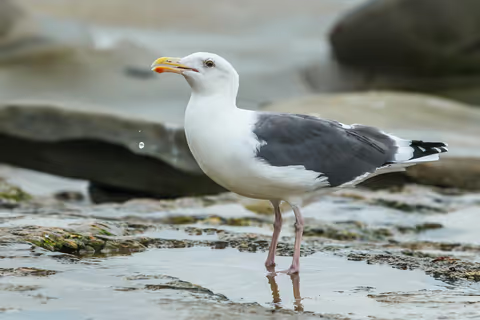
The western gull (Larus occidentalis) is rarely found far from the Pacific Ocean. Their year-round range extends along the Pacific Coast of North America from the southern half of Washington to Baja California. In the winter, their range extends north into British Columbia and south to Baja California Sur. As this range suggests, some populations are migratory while others are not.
Western gulls are large, about 22-26 inches in length with a 47 to 57 inch wingspan. Breeding adults have white heads, necks and bodies with dark gray backs and wings. Their tail feathers are black with white spots, their legs and feet are pink, and their bills are yellow with a red spot on the lower mandible.
Western gulls nest in colonies, sometimes with other gull species, on islands or offshore rocks. Nests are built in a depression in the ground lined with vegetation, feathers, and other such items. Clutch size is usually about three eggs; any more than this is the result of multiple females laying in the same nest. Eggs are incubated by both parents for about a month. The young may leave the nest a few days after hatching, but they don’t go far. They are capable of flight around 6-7 weeks of age and at ten weeks old they become independent and leave the colony.
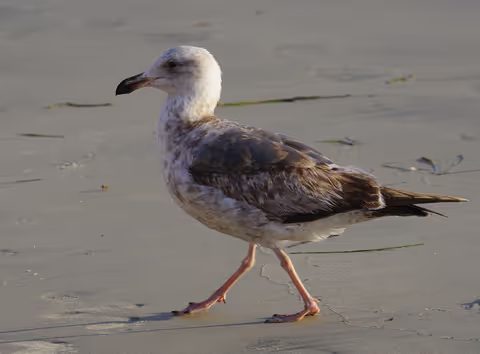
It takes four years for western gulls to reach sexual maturity. Juveniles have black bills and their plumage is grayish brown and mottled. As they mature, they gradually lose these features. Nonbreeding adults have light streaking on their necks. They live to about 25 years of age.
The western gull often crossbreeds with the glaucous-winged gull, resulting in hybrids informally known as Olympic gulls. These hybrids tend to resemble Thayer's gulls, but are distinguished by flatter, larger heads and thicker bills. In Washington, particularly in the northern half of the state, these hybrids are quite common, sometimes more so than “pure” western gulls. Grays Harbor seems to be the point where predominance between “pure” western gulls and hybrids becomes divided. According to the Washington NatureMapping Program, “A zone between Grays Harbor and Destruction Island contains roughly equal amounts of Western, Glaucous-winged, and integrated [sic] gulls breeding in colonies. South of Grays Harbor, Western is the predominant large Larus gull.” However, they do report large colonies of “pure” gulls occurring in the county.
Western gulls don’t dive like other seabirds do. Instead they feed from the water’s surface. Their diet includes squid, jellyfish, mollusks, sea stars, sea urchins, krill, and small fish. They are also opportunistic feeders who will scavenge carrion and refuse, as well as prey on other shorebirds. In fact, colonies often set up their nests near other breeding birds or marine mammals so they can steal eggs, chicks, deceased young, and even milk from lactating female seals.
Western gulls have one of the most restricted ranges of any North American gull species and therefore are susceptible to changes in their environment due to human activity, such as climate change, oil spills, and ocean acidification. The IUCN Red List estimates their population to be 115,500 and 118,500 individuals and their numbers appear to be increasing. While they are currently considered to be of least concern, it is important they continue to be monitored.
References
BirdLife International. (2018). Larus occidentalis (Western Gull). Retrieved May 23, 2021, from https://www.iucnredlist.org/species/22694337/132543621
Cornell Lab of Ornithology. (n.d.). Western Gull. Retrieved May 22, 2021, from https://www.allaboutbirds.org/guide/Western_Gull/overview
National Park Service. (2016). Western gull. Retrieved May 23, 2021, from https://www.nps.gov/chis/learn/nature/western-gull.htm
Seattle Audubon Society. (n.d.). Western gull. Retrieved May 22, 2021, from http://www.birdweb.org/birdweb/bird/western_gull
Washington NatureMapping Foundation. (n.d.). Western gull. Retrieved May 23, 2021, from http://naturemappingfoundation.org/natmap/facts/western_gull_712.html
© Laura Caldwell, May 2021
Touch whale bones, examine shipwreck artifacts and connect with the coast's living history.

Support our mission, get involved in educational programs, or contribute through donations and volunteering.