Birds
Glaucous-Winged Gull
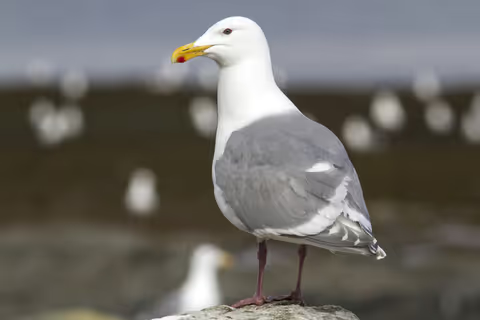
The glaucous-winged gull (Larus glaucescens) is one of the most widespread gulls in Washington State. They can be found year-round on the Pacific coast from Washington to Alaska and south through Mexico during the winter. They prefer salt or brackish waters and as such are rarely found far inland.
Glaucous-winged gulls are large gulls, about 24-27 inches long with a 54 inch wingspan, and can be easy to spot in a mixed flock since they lack the black coloration on the wingtips most other gulls have. Breeding adults have a pale bluish-gray back and wings which give it its name (the word “glaucous” is derived from the Greek glaukos, which refers to the bluish-gray color). Their head, underparts, and tail are white while their legs are pink. Their beaks are yellow with a red spot on the lower mandible and have a pronounced angle.
Like other gulls in the Pacific Northwest, glaucous-winged gulls take four years to reach sexual maturity. Juveniles are pale brown and mottled with a black beak. These traits are gradually replaced with their adult characteristics as they age. Nonbreeding adults have a mottled, pale brown head and neck.
The exception is when they breed with other gulls, such as the western gull or the herring gull. In Washington State, glaucous-winged x western hybrid gulls can be more widespread than either of their parents. According to the Cornell Lab of Ornithology, these hybrid gulls are informally known as “Olympic gulls.” The hybrids have black wingtip coloring and often resemble Thayer’s gulls. However, their heads are flatter and larger than those of Thayer’s gulls and they also have thicker bills.
Glaucous-winged gulls are omnivorous and their diet can vary greatly depending on local availability. Their diet can include fish, marine invertebrates, seaweed, small birds and mammals, eggs, human refuse, and carrion. They sometimes follow predators such as bears, eagles, and fishermen to forage their scraps. They may even eat chicks of their own species.
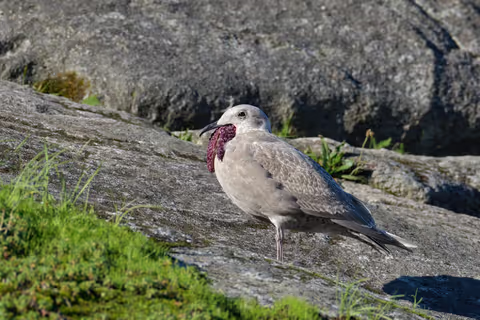
The methods they use to obtain food are just as varied. Like many large gull species, they forage and drop hard-shelled creatures like clams onto rocks in order to break them open. Unlike western gulls, they are capable of diving to get food from the water. They are often willing to steal food from other seabirds, prey on small bird or mammals, and approach humans in search of refuse or handouts.
Breeding begins in the spring, when males and females form pairs within their colonies. These pairs may remain together for multiple breeding seasons. The pair selects and builds a nest together. These nests are usually a scrape in the ground filled with vegetation that average about 15.2 inches across, but they may also nest on wharves, roofs, or similar structures. The latter is more likely to occur in the Puget Sound area than along the Washington coast. Both the male and female share in incubation, nest guarding, and feeding duties.
Clutch size is usually 1-4 eggs and the incubation period lasts about four weeks. They may leave the nest a day or two after hatching, but they do not go far. Fledging occurs 5-7 weeks after hatching and the young leave the colony 7-9 weeks after hatching.
Glaucous-winged gulls are of least concern on the IUCN Red List with their population seeming to be increasing. The University of Michigan Museum of Zoology suggests their population might be on the rise due to increased accessibility of human refuse. Currently, the largest threat to glaucous-winged gulls is the loss of suitable prey and habitat due to climate change and pollution.
References
BirdLife International. (2018). Glaucous-winged Gull. Retrieved June 06, 2021, from https://www.iucnredlist.org/species/22694334/132543276
Bullard, T. (2001). Larus glaucescens Glaucous-winged Gull. Retrieved June 04, 2021, from https://animaldiversity.org/accounts/Larus_glaucescens/
Cornell Lab of Ornithology. (n.d.). Glaucous-winged gull. Retrieved June 04, 2021, from https://www.allaboutbirds.org/guide/Glaucous-winged_Gull/overview
Ebels, E., Adriaens, P., & King, J. (2001). Identification and ageing of Glaucous-winged Gull and hybrids. Dutch Birding, 23(5), 247-270. Retrieved June 20, 2021, from http://www.gull-research.org/glaucescens/pfds/Identificationof.pdf
Kauffman, K. (2019). Glaucous-winged gull. Retrieved June 05, 2021, from https://www.audubon.org/field-guide/bird/glaucous-winged-gull
Seattle Audubon Society. (n.d.). Glaucous-winged gull. Retrieved June 04, 2021, from http://www.birdweb.org/birdweb/bird/glaucous-winged_gull
© Laura Caldwell, June 2021
Edited June 20th, 2021 to replace a broken link in the reference list.
Touch whale bones, examine shipwreck artifacts and connect with the coast's living history.

Support our mission, get involved in educational programs, or contribute through donations and volunteering.