Birds
Olympic Gull
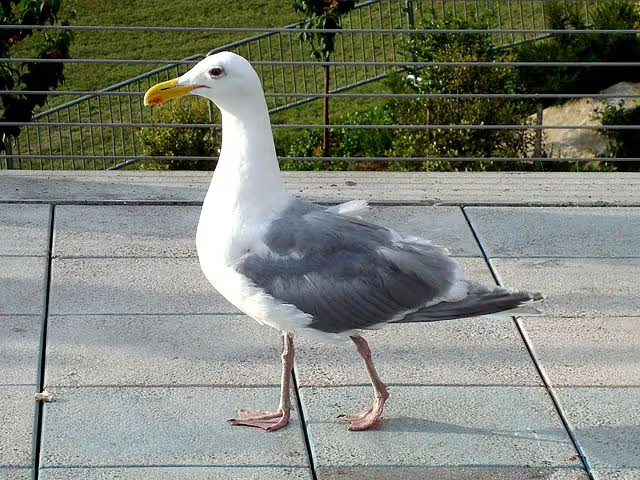
As there are over fifty species of gull worldwide and they have a tendency to hybridize, gull identification can be a challenging endeavor for even the most experienced birders. Hybrid gulls typically have traits associated with both their parent species and the end result can make them look similar to another species entirely. This is the case with Washington State’s most well known hybrid: the Olympic gull (Larus occidentalis x glaucescens).
Olympic gulls, also referred to as Puget Sound gulls, are a hybrid of western gulls (Larus occidentalis) and glaucous-winged gulls (Larus glaucescens). They usually display intermediate characteristics to their parent species, “typically with mantle and primaries that are too dark for Glaucous-winged but too light for Western Gull” (Bird Studies Canada, 2012). According to Ebels, Adriaens, and King, “Any Glaucous-winged type showing a contrasting blackish hue in the otherwise grey primaries and/or a rather dark underside of the folded wing-tip or the remiges in flight is unlikely to be ‘pure’” (2002). That said, characteristics can vary wildly between individual Olympic gulls and they can very closely resemble either of their parent species.
These intermediate characteristics can make Olympic gulls resemble other gull species. In particular, Olympic gulls often resemble Thayer’s gulls (Larus glaucoides thayeri), which in their adult breeding plumage have a pale gray mantle with blackish wingtips and white head, neck, breast, and underparts. However, Olympic gulls can be distinguished by their heads, which are larger and flatter than those of Thayer’s gulls, and they have thicker bills.
Hybridization occurs when the range of two gull species overlap. This is exactly the case with Olympic gulls in the state of Washington. While both western and glaucous-winged gulls can be found anywhere along the Washington Coast, pure glaucous-winged gulls are more commonly found in the northern part of the state while pure western gulls are more commonly found in the southern half. Bell defines the hybrid zone for Larus occidentalis x glaucescens as between Protection and Tatoosh Islands in Washington to Coos Bay, Oregon with Grays Harbor serving as the midway point (1996). That said, Olympic gulls, particularly non-breeding gulls, can be found as far north as southeast Alaska and as far south as Baja California.
Olympic gulls are just as fertile as their parent species and tend to display similar breeding behaviors, such as forming colonies during the breeding season and building nests on the ground. In a study on breeding sites in Grays Harbor conducted between 1994 and 1997, it was found that nests located in vegetated areas had higher success rates than those in open sandy areas as the gulls did not have to spend as much time chasing predators away from the nests (Good, 2002). Said predators are often other gulls. In fact, Good observed when some gulls were chasing off a predator, such as a bald eagle, other gulls in their colony would take advantage of their absence to prey on the unguarded eggs.
Sea surface temperature is another factor leading to nest success among Olympic gulls. In a study conducted on Protection Island between 2006 and 2011, researchers found rising sea surface temperatures led to decreased nest success and greater instances of gulls preying on their own eggs. Rises in sea surface temperature lead to prey relocating to deeper, cooler waters. This is turn reduces the food supply for surface feeding birds such as Olympic gulls and their parent species, which forces them to resort to cannibalism (Hayward et al, 2014).
Their diet is similar to that of their parent species, including their penchant for cannibalism. A typical diet for both Olympic gulls and their parent species includes marine invertebrates such as sea stars, mussels, clams, crabs, limpets, sea urchins, and barnacles, as well as fish, carrion, and human refuse.
In Washington, there are areas where Olympic gulls outnumber both of their parent species. This is especially likely to occur near the midway point of the hybrid zone, namely around Grays Harbor, Destruction Island, and Willapa Bay. Further north in their range, colonies are more likely to contain “pure” glaucous-winged gulls while further south they are more likely to contain “pure” western gulls (Bell, 1996). So for everyone trying to identify whether the gulls around Ocean Shores are Olympic gulls, get as close of a look as you can without disturbing them. You might be surprised by what you find.
References
Bell, D. (1996). Genetic Differentiation, Geographic Variation and Hybridization in Gulls of the Larus glaucescens-occidentalis Complex. The Condor, 98(3), 527-546. Retrieved June 13, 2021, from https://www.jstor.org/stable/1370471
Cannings, R. (2012). Identifying Hybrid and Immature Gulls in Coastal B.C. [PDF]. Port Rowan, Ontario: Bird Studies Canada. Retrieved June 15, 2021, from https://www.birdscanada.org/wp-content/uploads/2020/04/Immature-HybridGulls.pdf
Cornell Lab of Ornithology. (n.d.). Glaucous-winged gull. Retrieved June 04, 2021, from https://www.allaboutbirds.org/guide/Glaucous-winged_Gull/overview
Ebels, E., Adriaens, P., & King, J. (2001). Identification and ageing of Glaucous-winged Gull and hybrids. Dutch Birding, 23(5), 247-270. Retrieved June 20, 2021, from http://www.gull-research.org/glaucescens/pfds/Identificationof.pdf
Good, T. (2002). Breeding Success in the Western Gull × Glaucous-Winged Gull Complex: The Influence of Habitat and Nest-Site Characteristics. The Condor, 104(2), 353-365. Retrieved June 13, 2021, from http://www.jstor.org/stable/1370037
Hayward, J., Weldon, L., Henson, S., Megna, L., Payne, B., & Moncrieff, A. (2014). Egg cannibalism in a gull colony increases with sea surface temperature. The Condor, 116(1), 62-73. Retrieved June 20, 2021, from http://www.jstor.org/stable/90008047
© Laura Caldwell, June 2021
Touch whale bones, examine shipwreck artifacts and connect with the coast's living history.

Support our mission, get involved in educational programs, or contribute through donations and volunteering.