• Skip to primary navigation
  • Skip to main content
  • Skip to primary sidebar
  • Skip to footer
Coastal Interpretive Center Logo

Coastal Interpretive Center

  • Home
  • EXHIBITS
    • Indoor Exhibits
      • Olympic Coast National Marine Sanctuary
      • Children’s Exhibit
      • Coastal Watersheds Exhibit
      • Earth Sciences Exhibit
      • Habitat Wing
      • Beachcombing Exhibit
      • Logging on the WA Coast
      • Quinault Indian Nation
      • Ocean Shores History
      • Shipwrecks
      • Whales, Dolphins & Porpoises
    • Outdoor Exhibits
      • Gardens
      • Ocean Shores History
      • Whaling
      • Shipwrecks
      • FADs
      • Trails
    • High Dunes Trail
      • Dune Ecosystems and Communities
      • High Dune Biodiversity
      • High Dune Wetlands
      • High Dune Wildlife
      • Invasive Species in the High Dunes
      • Coastal Sand Dunes
  • RESOURCES
    • Education Programs Catalog
    • Activities For Kids
    • Glimpses Lecture Series
    • Videos
      • Book Reviews
      • Exploring the Washington Coast
      • Family Crafts and Education
      • Winged Wonders
    • Coastal Glimpses Newsletter Archive
    • Ocean Shores
    • Ocean Shores History Comes Alive!
  • BLOG
  • ABOUT
    • CENTER TEAM
    • CENTER HISTORY
    • CENTER INFORMATION
    • State of the Museum
    • Bookstore
    • Careers
    • Frequently Asked Questions
    • Raves
  • Events
    • Event Calendar
  • Contribute
    • Membership
    • Sand Dollar Society
    • Donate
    • Volunteer
  • Contact

10 Signs of Spring

December 20, 2021 by Holly Duffy

10 Signs of Spring in Western Washington
(and when to expect to see them)

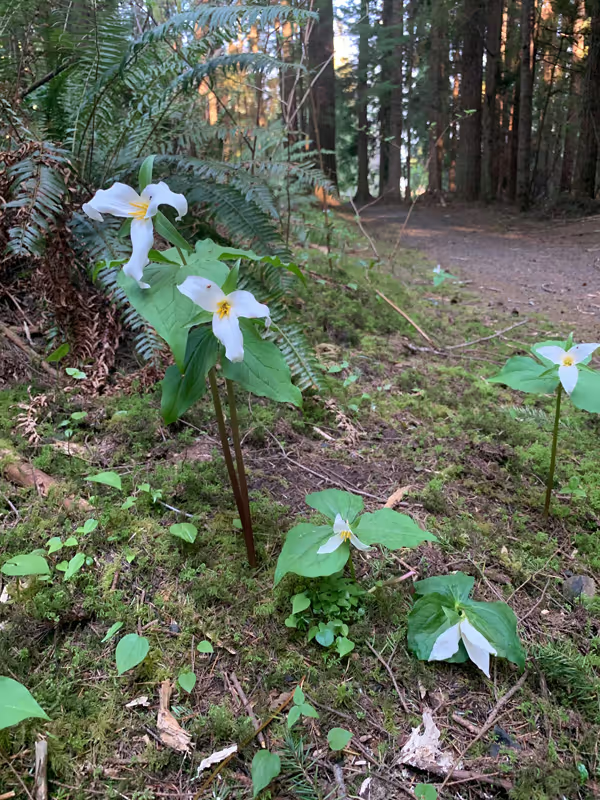
Photo of Trilliums by Holly Duffy

The winter solstice will happen this Tuesday, marking the first day of winter in the northern hemisphere with the shortest day of the year. On December 21, 2021, those of us in Western Washington can look forward to exactly 8 hours 28 minutes and 29 seconds of daylight. Thankfully, after the winter solstice, we will gain daylight every day until we reach the summer solstice and longest day of the year. As we inch out of the darkness, here are 10 signs of spring to look forward to:

  1. Indian Plum begins to bud in February, hinting that a change in the seasons is on the way. By the time spring officially hits, the Oemleria cerasiformis will be in full bloom with bursts of white flowers and purple berries.
  2. Rough Skinned Newts and their bright orange bellies will begin to make their way towards ponds, wetlands, and other breeding grounds, in February.
  3. “Chick-a-dee-dee-dee” will be heard in mid-February as Chickadees come out to sing.
  4. Great Blue Herons will be easy to spot in February and March, with kids generally born in April and out and about through July.
  5. Skunk Cabbage will begin to bloom in late February, emitting its signature odor through spring to attract pollinators like bees and butterflies.
  6. Trilliums will begin to bloom in early March. Another name for this three-petalled flower is the “wake robin,” as it tends to bloom at the same time that robins return to the forest.
  7. “Wildflower Season” will begin in March as a variety of flora bring pops of color to forests throughout Western Washington.
  8. Grey Whales will be migrating north and easy to spot from our shores in late March.
  9. Migratory shorebirds will begin to arrive on rocky shores, sandy beaches, mudflats and estuaries in April.
  10. Rhododendrons, the Washington State Flower, will burst into color in late April to May.


Sources

Baley, Anne. “Skunk Cabbage Facts.” Gardening Know How. https://www.gardeningknowhow.com/ornamental/flowers/skunk-cabbage/skunk-cabbage-facts.htm. Accessed 19 December 2021.

Cockrell, Debbie. “Hello, sunsets before 5 p.m. Tacoma heading into the long, dark days of winter.” Tacoma News Tribune. www.thenewstribune.com/news/local/article255603596.html. Accessed 19 December 2021.

Ferrell, Matt. “Seven Signs that Spring is Springing in the North Cascades.” North Cascades Institute. https://blog.ncascades.org/naturalist-notes/seven-signs-that-spring-is-springing-in-the-north-cascades/. Accessed 19 December 2021.

Savych, Olha. “Best Time to See Pacific Rhododendrons.” Rove. https://rove.me/to/washington-wa/pacific-rhododendron. Accessed 19 December 2021.

Schulman, Neil. “Signs of Spring in the Northwest.” The Clymb. https://blog.theclymb.com/out-there/signs-spring-northwest/. Accessed 19 December 2021.

Smith, Kyle. “Spring Color Comes to Coastal Forests of Washington.” The Nature Conservancy: Washington State. https://www.washingtonnature.org/fieldnotes/spring-color-comes-to-the-coastal-forests-of-washington. Accessed 19 December 2021.

“Washington in Bloom: 12 Spring Hikes for Wildflowers.” Washington Trails Association. https://www.wta.org/go-outside/seasonal-hikes/spring-destinations/spring-wildflower-hikes. Accessed 19 December 2021.

© Holly Duffy, December 2021


Category iconSeasons Tag iconNorthern Hemisphere,  Seasons,  Solstice,  Spring,  Winter

Primary Sidebar

Hey, Did You Know?

  • The Pacific Tree Frog: Part 2
  • The Pacific Tree Frog: Part 1
  • Bigleaf Maple

Follow CIC

  • Email
  • Facebook
  • Instagram
  • Phone
  • Twitter
  • YouTube

Categories

Tags

Beachcombing Bears Birds Bird Watching Black Bears Botanical Botany Cats Coastal Watersheds Cougars Ducks Flowers Gardening Geology Gulls Hummingbirds Invasive Species Large Mammals Life Cycle Lions Mammals Marine Life Migratory Birds Mountain Lions Native Plants Native Species Nature Oceans Ocean Shores Ocean Shores History Olympic Peninsula Pacific Coast Pacific Northwest Pacific Ocean Plants Pumas Sea Stars Shrubs Songbirds Spring Trees Waterfowl Weather Wildlife Winter

Footer

EXPLORE OUR BLOG

  • The Pacific Tree Frog: Part 2
  • The Pacific Tree Frog: Part 1
  • Bigleaf Maple

FIND US

1033 Catala Ave SE,
Ocean Shores, WA 98569
360-289-4617

Hours: Saturday and Sunday, 10:00am to 4:00pm
Closed Monday - Friday


Terms and Conditions of Use / Privacy Policy

© 2022 Coastal Interpretive Center

FOLLOW CIC

  • Email
  • Facebook
  • Instagram
  • Phone
  • Twitter
  • YouTube

SIGN UP FOR OUR NEWSLETTER

The Skulls & Evolution Exhibit features a selection of skulls from animals native to the Washington Coast. Discover how these animals relate to one another and how functions like eating affect shape their skull structure.

This Exhibit will be on display through January 28, 2024.