Nature
Yellow Flag Iris
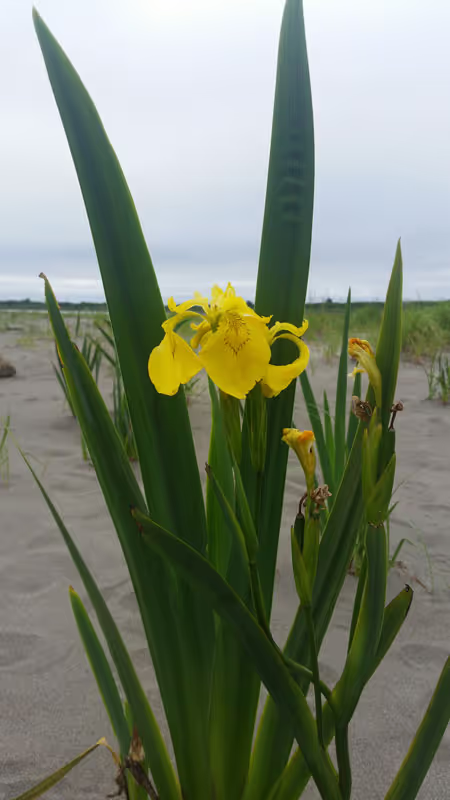
If you’ve taken a walk through the dunes in the late spring, you have probably seen yellow irises blooming. These are yellow flag irises (Iris pseudacorus). Native to Europe, North Africa, and temperate areas in Asia, the iris is an invasive plant found within 40 US states and 7 Canadian provinces. In Washington, it is a Class C noxious weed especially prevalent within Grays Harbor, Pacific, Mason, Thurston, King, Kitsap, and Douglas counties (WA Noxious Weed n.d.).
Yellow flag irises are perennials that grow to about 2-3 feet tall. They have long, dark green, flat leaves with about 10 leaves per clump. The leaves are upright and fan out slightly from the base. The plant is in bloom from May-June. The flowers are pale to dark yellow with brown or purple lines. They have three petals and three sepals and several flowers can occur on each stem.
They are found in freshwater and brackish riparian areas. As the only yellow iris growing in Washington’s wetlands, they are easily identifiable when in bloom (King County). When not in bloom, they can resemble common cattails (Typha latifolia), though they can be distinguished by size as cattails are generally larger.
Yellow flag irises reproduce both through seeds and through rhizomes. Seed pods are three-sided and 1.5-3 inches in length. They contain numerous brown seeds. The rhizomes are 0.4 to 2 inches in diameter and the roots can be up to 1 foot in length. Several hundred plants can be connected via rhizomes and a new plant can form from just a fragment of the rhizome. Rhizomes can remain viable for several months.

Because they can form so densely, they tend to outcompete native plants. On top of reducing plant diversity, yellow flag irises can reduce the amount of space available in wetland habitats for fish and waterfowl. They can block small streams, reduce stream width by trapping sediments within their roots, and block human-made structures such as irrigation systems and pipes (USFWS 2019). The plants also have the ability to remove metals from the water, changing the water composition.
Yellow flag iris is harmful to both humans and animals. While unlikely to cause fatalities, the roots and the sap can cause skin irritation in humans if handled and nausea and vomiting if consumed. The plants are also toxic to livestock and pets if consumed, though most herbivores will avoid them. That said, yellow flag irises have been used as cathartics.
They were brought to North America as ornamental plants in the early 1900s, though there have been recorded sightings that predate this in the northeastern United States (USFWS 2019). The Grays Harbor County Noxious Weed Board requires yellow flag iris be prevented from spreading (GH Noxious Weed 2022). It is also on the state quarantine list, meaning it cannot be transported, bought, sold, or distributed in Washington State (WA Dept of Agriculture 2021).
Yellow flag irises can be removed by hand, though one should wear gloves while handling them and make sure to remove the rhizomes completely. They can also be controlled by removing the stems and applying herbicide to the stump. Burning is not recommended as both seeds and rhizomes remain viable after burning (WA Noxious Weed n.d.).
References
Grays Harbor Noxious Weed Board. (2022). Grays Harbor County 2022 Noxious Weed List. Montesano, WA. Retrieved December 22, 2022, from https://s3.wp.wsu.edu/uploads/sites/2062/2022/01/2022-Weed-List.pdf
Metro Vancouver and the Invasive Species Council of Metro Vancouver. (2021, August). Best Management Practices for Yellow Flag Iris in the Metro Vancouver Region. Burnaby, British Columbia. Retrieved December 23, 2022, from http://www.metrovancouver.org/services/regional-planning/PlanningPublications/YellowFlagIrisBMP.pdf
U.S. Fish and Wildlife Service. (2019). Yellow Flag Iris (Iris pseudacorus) Ecological Risk Screening Summary. Washington D. C. Retrieved December 22, 2022, from https://www.fws.gov/sites/default/files/documents/Ecological-Risk-Screening-Summary-Yellow-Flag-Iris.pdf
Washington State Department of Agriculture. (2021). Prohibited Plants and Seeds in Washington State. Olympia, WA. Retrieved December 22, 2022, from https://cms.agr.wa.gov/getmedia/9e83eb5b-8131-48a9-9066-aa76f077a219/brochureprohibitedplants.pdf
Yellow Flag Iris. Washington State Noxious Weed Control Board. (n.d.). Retrieved December 23, 2022, from https://www.nwcb.wa.gov/weeds/yellow-flag-iris
Yellow Flag Iris. WSU Clark County Extension. (n.d.). Retrieved December 23, 2022, from http://www.pnwplants.wsu.edu/PlantDisplay.aspx?PlantID=57
Yellow flag iris identification and control. King County Noxious Weed Control Program. (n.d.). Retrieved December 23, 2022, from https://kingcounty.gov/services/environment/animals-and-plants/noxious-weeds/weed-identification/yellow-iris.aspx
© Laura Caldwell, January 2023
Touch whale bones, examine shipwreck artifacts and connect with the coast's living history.

Support our mission, get involved in educational programs, or contribute through donations and volunteering.