Pacific Ocean
Whale Barnacles
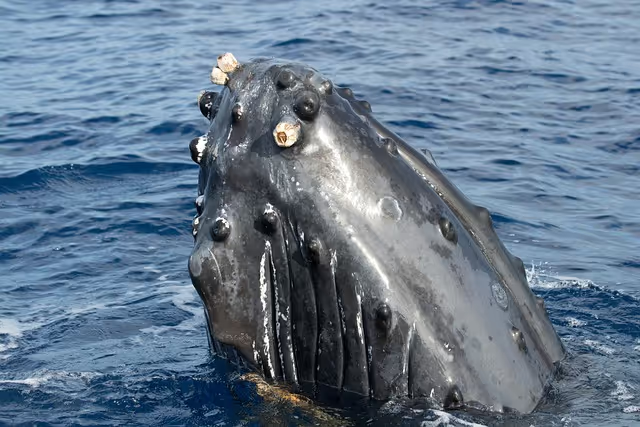
Whale barnacles are a group of acorn barnacles from the family Coronulidae. They spend their lives attached to the skin of whales--usually baleen, but sometimes they attach themselves to toothed whales. Some species of whale barnacles can live on any whale species while others live exclusively on a particular whale species. Whales can host several hundred pounds of barnacles on them.
Whale barnacles begin their lives as free-floating larvae. When they find a spot on the whale to settle, they begin growing their shells and anchor themselves to the whale’s skin. The shells are composed of six plates made of calcium carbonite and chiton with a hole at the top. Their heads remain within the shell and they extend their cirri out of the hole to feed.
The reproduction of whale barnacles is thought to coincide with the reproduction of their host whales (National Marine Sanctuary Foundation 2022). During the breeding season, whales tend to congregate in one area, which makes it easier for barnacle larvae to find a suitable host. To reproduce, they extend their genitalia out through the hole in their shell to mate with a nearby barnacle.
Whale barnacles live for about a year, after which they slough off the whale naturally. They may also fall off during fights with predators or between males, or a whale may scrape barnacles off their bodies. Like other species of barnacles, they can leave behind white marks called barnacle scars.

Whales are thought to have a commensal relationship with whale barnacles, which means that the barnacles benefit while they neither help nor harm the whale. While it is not currently known what benefits, if any, the whales get from the barnacles, there are theories that suggest the barnacle shells provide the whale with armor. On the flip side, the barnacles can also slightly increase the whale’s drag while swimming.
There are two main benefits for the barnacles. First, as filter-feeders, it allows them easy access to areas with plenty of food. Second, being attached to a moving creature makes it more difficult for barnacle predators, such as gulls or sea snails, to get ahold of them.
Whale barnacles are not well studied. For starters, it is difficult for humans to obtain live whale barnacles. They cannot be collected from living whales without cutting into the whale’s skin. Whale strandings are rare, and when they do strand any barnacles attached tend to die quickly. If whale barnacles do happen to make it back to a lab alive, it can be difficult to keep them alive long enough for a study to be completed (Grunbaum 2021).
However, there is one area of study whale barnacles are proving themselves invaluable for: whale migration. Much like how tree ring growth can provide insight into the conditions of a forest, whale barnacle shells also keep a record of the water conditions around them as they grow via changes in oxygen isotope ratios. By analyzing the shells, scientists can learn which bodies of water the barnacle, and thus the whale, traveled through. And as these records remain evident on fossilized whale barnacles, scientists are able to determine historic whale migration patterns. This may in turn help scientists predict how whales will respond to climate change (Taylor et al 2019).
References
Grunbaum, M. (2021, November 9). What whale barnacles know. Hakai Magazine. Retrieved March 23, 2023, from https://hakaimagazine.com/features/what-whale-barnacles-know/
Kenney, R. (2020, November 11). A barnacle stranding at Block Island . Rhode Island Natural History Survey. Retrieved March 23, 2023, from https://rinhs.org/barnacle-stranding/
National Marine Sanctuary Foundation. (2022, December 9). Whales and barnacles: Save the whales: Whale species. Retrieved March 23, 2023, from https://marinesanctuary.org/blog/whales-and-barnacles-an-unlikely-duo/
Smithsonian Tropical Research Institute. (2019, April 2). Hitch-hiking barnacles. Smithsonian Tropical Research Institute. Retrieved March 23, 2023, from https://stri.si.edu/story/hitch-hiking-barnacles
Taylor, L. D., O’Dea, A., Bralower, T. J., & Finnegan, S. (2019). Isotopes from fossil coronulid barnacle shells record evidence of migration in multiple pleistocene whale populations. Proceedings of the National Academy of Sciences, 116(15), 7377–7381. https://doi.org/10.1073/pnas.1808759116
© Laura Caldwell, March 2023
Touch whale bones, examine shipwreck artifacts and connect with the coast's living history.

Support our mission, get involved in educational programs, or contribute through donations and volunteering.