Nature
Western Pond Turtle
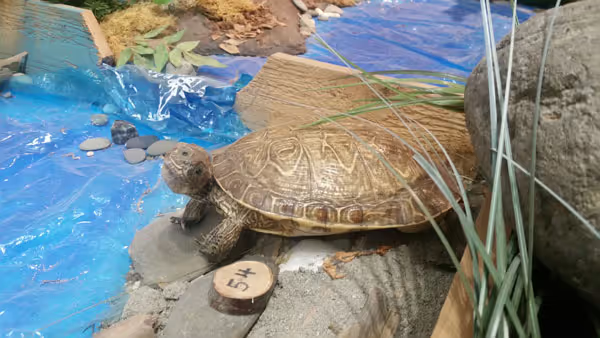
The western pond turtle (Actinemys marmorata) is one of two turtles native to Washington State, the other being the painted turtle (Chrysemys picta) who the species frequently cohabitates with. They are a medium-sized turtle that can be found from the Puget Sound Lowlands in Washington State to northern Baja California. They are more abundant in the southern areas of their range then they are in Washington, where they listed as an endangered species. There is significant regional variation in western pond turtles in terms of physical characteristics, behavior, and mortality; here we will focus on the variations found in Washington’s turtles.
Western pond turtles are dark brown to olive with a yellowish-colored underside. They are capable of growing up to 8.2 inches (210mm) and over 2.2 pounds (1kg). The color and size of western pond turtles varies by range and in the northern part of their range, turtles are usually darker and larger than they are in the southern parts. Juveniles have mottling on their heads and necks.
The turtles spend most of their lives in water, but require land for nesting, basking, and periods of inactivity, including overwintering and aestivation (a state of inactivity entered during the hottest days of the year). They also require regular sun exposure in order to maintain their body temperature. Despite their name, they are more typically found in rivers, streams, and wetlands and as they are very cautious of potential predators, they prefer areas with plenty of places to hide, such as rocks, logs, submerged vegetation, and holes or undercuts in the bank.
Western pond turtles reach sexual maturity at 4.3 inch (110 mm) minimum shell length. In Washington, males tend to reach this at 10-12 years old and females at 14-17 years old. Eggs are laid every other year between May and July and clutch size ranges between 2-13 eggs. Incubation time ranges between 95 and 127 days. Their estimated lifespan is 50-70 years.
Western pond turtles are omnivorous, though they primarily feed on aquatic invertebrates, small fish and frogs, and carrion. Aquatic plants, such as cattails and water lily pods, and algae are sometimes eaten, particularly by post-partum females. The turtles cannot swallow in air and must bring any land-scavenged food to the water to eat. They are preyed upon by black bears, coyotes, raccoons, gray foxes, river otters, and raptors while juveniles are preyed upon by frogs and fish.
In the 1980s western pond turtles had been extirpated from the Puget Sound lowlands and in the 1990s, there were an estimated total of no more than 200 individuals in two sites in the Columbia River Gorge: one in Klickitat County and one in Skamania County. Populations have declined in Washington due to commercial harvest, loss of habitat, and the introduction of non-native predators, such as American bullfrogs (Lithobates catesbeianus). Disease is also a threat, having killed a third of the Klickitat County population in 1990.
Thanks to recovery efforts, they have been reintroduced to Puget Sound and now have an estimated statewide population of 800 individuals at 6 sites. One such effort is that by the Washington Department of Fish and Wildlife, Woodland Park Zoo, and the Oregon Zoo, who remove bullfrog eggs from pond turtle sites and collect and raise western pond turtles in captivity until they are too large to by preyed upon by invasive species.
References
Burke Museum. (n.d.). Western pond turtle. Burke Museum. Retrieved December 29, 2021, from https://www.burkemuseum.org/collections-and-research/biology/herpetology/amphibians-reptiles-washington/western-pond-turtle
Hallock, L. A., A. McMillan, and G. J. Wiles. 2017. Periodic status review for the Western Pond Turtle in Washington. Washington Department of Fish and Wildlife, Olympia, Washington. 19+v pp. Retrieved December 29, 2021, from https://wdfw.wa.gov/sites/default/files/publications/01853/wdfw01853.pdf
Hays, D. W., K. R. McAllister, S. A. Richardson, and D. W. Stinson. 1999. Washington state recovery plan for the western pond turtle. Wash. Dept. Fish and Wild., Olympia. 66 pp. Retrieved December 29, 2021, from https://wdfw.wa.gov/sites/default/files/publications/00398/wdfw00398.pdf
Washington Department of Fish and Wildlife. Western pond turtle (Actinemys marmorata). Washington Department of Fish and Wildlife. Retrieved December 29, 2021, from https://wdfw.wa.gov/species-habitats/species/actinemys-marmorata
"Western Pond Turtle" 2001.19.01. Coastal Interpretive Center.
Woodland Park Zoo (n.d.). Western pond turtle recovery project. Woodland Park Zoo. Retrieved December 30, 2021, from https://www.zoo.org/turtles
© Laura Caldwell, January 2022
Touch whale bones, examine shipwreck artifacts and connect with the coast's living history.

Support our mission, get involved in educational programs, or contribute through donations and volunteering.