Birds
Waxwings: Wandering Wonders
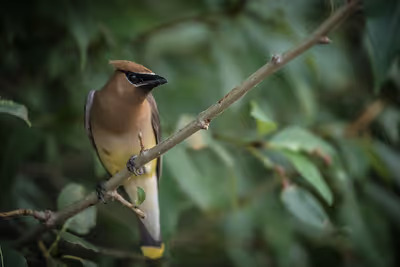
Cedar Waxwing
On a recent afternoon paddle of the Little Hoquiam River, I was treated to the sight of some Cedar Waxwings quietly flittering around. This wasn’t a big gathering flock that would be typical in late fall or winter, so I’m making a guess they were busy with nest-building, insect-catching, or egg-tending. A discussion arose between us, my paddling buddies & me, about Cedar Waxwings and Bohemian Waxwings, the two North American species of waxwings. There is just one more species globally, the Japanese Waxwing in eastern Asia; it was, sadly, left out of the discussion.
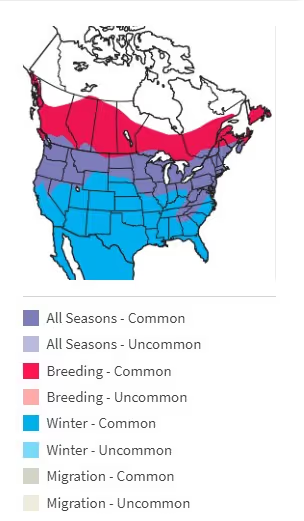
Cedar Waxwing range map
In western Washington it is almost certain a waxwing you encounter will be of the Cedar persuasion. BirdWeb (Seattle Audubon) and All About Birds (Cornell Laboratory of Ornithology) agree that Bohemian Waxwings occur irregularly (i.e. scarcely) west of about Cle Elum, Washington, and if appearing there it will be in winter. This species breeds in the far northern reaches of North America (Alaska, Yukon, Northwest Territories) and wanders southward in the winter between the Cascades and the Rockies perhaps to Colorado, although can be seen less commonly across North America to the east. Cedar Waxwings have a wider range across the full east-west expanse of the U.S. and Canada, with the northern edges of their breeding range being south of the southern borders of Yukon and Northwest Territories, a year-round range approximately between the 40th and 50th parallels, and sightings during non-breeding season occurring southward across the continent to Central America. Deducing from the range maps, the two birds’ ranges overlap for part of the non-breeding season in northeastern Washington, Idaho, Montana, British Columbia, Alberta, and surrounds. In these areas, flocks can be a mixture of the two species and can also be associated with American Robins. Flock behavior can resemble starlings, with dense flocks swooping and dividing as they congregate in orchards, edge habitat, and even residential areas.
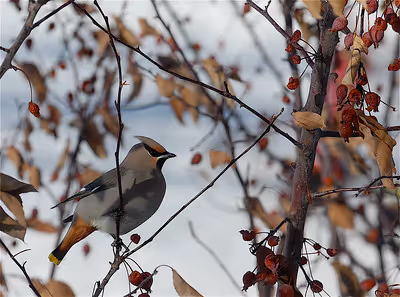
Bohemian Waxwing
I marked my first sighting of a single Bohemian Waxwing while on a stroll in the Bitterroot Range just west of Missoula, Montana. It quietly sat on a low, thin branch of a spruce tree and watched me pass. I hear they prefer to nest on a horizontal branch of a spruce tree, but this observation was outside of breeding time and area. Cedar Waxwings are more likely to choose a deciduous tree for nesting. Cedar Waxwings may have received the first part of their common name because cedar cones are one of their preferred snacks.
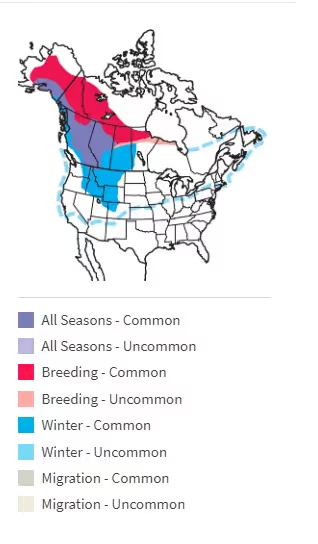
Bohemian Waxwing range map
Both species exhibit “bohemian” characteristics in that they are somewhat unconventional. They do not hold breeding territories, they move around in an unpredictable, nomadic fashion rather than a typical migration pattern, they communicate with high-pitched trilling calls instead of song, and they eat primarily fruit. Insects are caught and eaten and fed to young when first hatched, but fruit is what drives them and allows them to thrive throughout the year. Availability of fruit also makes waxwings one of the latest-nesting passerine birds. I was pleased to learn that Brown-headed Cowbird chicks planted in waxwing nests do not “bloom,” because they don’t develop well on the fruity diet. My first childhood knowledge of Cedar Waxwings was seeing them in the big hawthorn tree next to our house, feasting on the red berries.
The fruit waxwings eat contributes to the color of their tail feather tips (yellow to orange) and the waxy ends of their secondary wing feathers. These red waxy wing tips (obviously the source of the second part of their common name) increase in number and size as an individual bird ages. No purpose is known for the waxy secretions, but it seems to contribute to mate selection and nesting success. More and bigger red waxy wingtips means you are mature enough to do a good job!
In appearance, the Cedar Waxwing (Bombycilla cedrorum) differs from the Bohemian Waxwing (Bombycilla garrulus) in that its belly is white and yellow instead of gray, its tail coverts are white instead of rust-colored, and it lacks a white wing bar. The Bohemian has a light outline of white around its face mask and a blush tinge on its face. Both sport a crest of feathers. The Cedar is slightly smaller than the Bohemian; both birds are sized between a sparrow and a robin.
Audubon Christmas Birds Counts show that the populations of neither bird are in danger, but counts of Bohemian Waxwings indicate a slightly downward trend and contracting range while Cedar Waxwings seem to be expanding their range and are stable to increasing in numbers.
If you are interested in drawing Cedar Waxwings to your western Washington back yard, try growing fruit-bearing plants such as serviceberry, strawberry, hawthorn, mountain ash, raspberry, cherry, etc. Also have water, because, like most fruit-eating birds, they get thirsty. You can also try having cut-up fruit available on a platform feeder. But if you draw in a flock, your fruit crop may be demolished in minutes!
Audubon Society scientists have modeled drastic climate-change-caused range loss for both birds. Southern range will be lost and both birds will likely move north, with the Bohemian Waxwing being affected the most. Link to these range vulnerability illustrations here (Cedar Waxwing) and here (Bohemian Waxwing).
Image Credits:
Range Map images provided by: https://www.audubon.org/field-guide
© Virginia Molenaar, August 2020
Touch whale bones, examine shipwreck artifacts and connect with the coast's living history.

Support our mission, get involved in educational programs, or contribute through donations and volunteering.