In The Garden
Washington’s State Flower: The Pacific Rhododendron
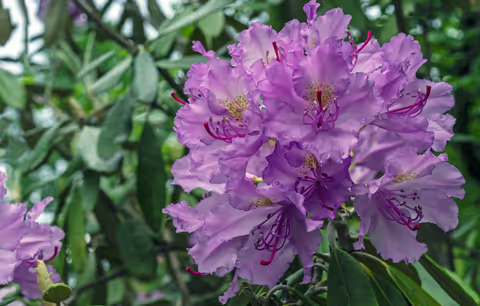
Rhododendrons, often referred to as “rhodies” are a common sight in gardens around the Pacific Northwest. As a whole, the genus Rhododendron contains over 1,000 varieties grown all over the world. But our state flower, the Pacific rhododendron, holds a particular appeal.
Rhododendron macrophyllum (meaning rose tree with large leaves), more commonly known as the Pacific rhododendron or the coast rhododendron, is native to the Pacific Northwest. They grow west of the Cascade Mountains between British Columbia and Northern California. They can be found from coastal areas to elevations around 6,000 feet. In Washington, wild plants are typically found in the Olympic Peninsula and the Cascade Mountain range.
They can grow between 5-25 feet in height and as such they can be grown as a shrub or a small tree. Their size is dependent on how much sunlight they receive and how they are maintained. Typically, rhodies that receive ample sun or are regularly pruned tend to grow closer to the ground while unkempt rhodies grown in shadier areas become taller. It is recommended they be grown in areas where they don’t need to be pruned as they are not as aesthetically appealing after pruning.
Pacific rhododendrons prefer well-draining, acidic soil with a low nitrogen content. In the wild, they grow as understudy plants in conifer forests alongside Western hemlock, Sitka spruce, Ponderosa pine, and Douglas fir. They can also thrive in disturbed areas such as roadsides, where they can help prevent erosion.
Pacific rhodies bloom between April and July, with plants in lower elevations blooming earlier than those in higher elevations. The flowers have five petals arranged in a bell shape with wavy edges and they grow in clusters of around 15-20 blooms. The color of the blooms can range from white to dark pink though they are typically light pink. They also often have yellow flecks.
The leaves are dark green, elliptic to oblong-shaped, and leathery. They range from 3-8 inches in length and 1-3 inches wide. They are evergreens, meaning they do not lose their leaves during the winter. To protect against the cold, leaves can roll themselves up. Leaves are retained for 2-3 years.
When they are five years old, Pacific rhodies begin to produce seeds. These seeds are less than 0.1 inches in size, including the wing. Seeds are produced in reddish-brown capsules between August and September and can remain viable up to two years.
Rhododendrons produce grayanotoxins in all parts of the plant and Pacific rhododendrons are no exception. These toxins affect humans, land mammals, and even bees. As the toxins are only fatal in high concentrations, some animals, such as mountain beavers, have been known to snack on them. Symptoms of grayanotoxin poisoning include weakness, fatigue, nausea, vomiting, low blood pressure, and cardiac rhythm issues.
Their toxicity limits their use by animals and humans alike. For animals, they are primarily used as shelter. For humans, they are largely decorative both in gardens and floral arrangements. In fact, the latter is how the Pacific rhododendron became Washington’s state flower.
In 1892, planning began for the National Garland of Flowers, a floral exhibition for the 1893 Chicago World’s Fair containing representative flowers from every state. As Washington did not have a state flower at the time, six candidates were entered into a vote. About 15,000 women from across the state participated in the vote as women were the only ones allowed to participate. Ultimately, the choice came down to two candidates: the Pacific rhododendron (known at the time as Rhododendron californicum) and the clover. The Pacific rhododendron emerged victorious; a decision approved by the state Senate just in time for the exhibition. However, it was only considered the state flower on a de-facto basis until the decision was approved by Washington Legislature in 1949. In 1959, the decision was updated to reflect the change in scientific name to Rhododendron macrophyllum.
Today, the Pacific rhododendron is a popular choice in local gardens as they are beautiful, easy to cultivate, and unappealing to deer. For a fun springtime activity, try seeing if you can find one the next time you’re in the Olympics. Whether on the roadside, the trail, or a native garden, seeing a Pacific rhodie in its natural environment is always a treat.
© Laura Caldwell, July 2020
Touch whale bones, examine shipwreck artifacts and connect with the coast's living history.

Support our mission, get involved in educational programs, or contribute through donations and volunteering.