Birds
The Short-Billed Gull (Mew Gull)
The Short-Billed Gull (scientific name: Larus brachyrhynchus) is small gull that was recently renamed. Until this year (2021), this species was often called "Mew Gull" (former scientific name: Larus Canus), and is still referred to by that name by some institutions, including The Audubon Society (1). The name change to "Short-Billed Gull" occurred when the species was split from the Common Gull of Eurasia. While its new name may be a more accurate reflection of the species, its old name has a fascinating history. While you might assume that "mew" would be derived from its catlike call, it is actually derived from “zee meeuw,” which is an old Dutch name for the bird. In Dutch, "Zee" means "sea", and "meeuw" means "gull". Because of this, you might be tempted to call this species a "seagull", as All About Birds has jokingly done (2). To do so, however, would not be entirely accurate because the Short-Billed Gull's breeding grounds extend into inland areas of Central Alaska and Northwestern Canada. With that being said, your best chances of seeing this wonderful bird in our corner of the world is along the coast, so perhaps you could get away with it (don't worry, we won't tell anyone). As of this writing (October 2021), it’s a little early for them to be showing up here in Ocean Shores, as Short-Billed Gulls tend to migrate later in the season. However, about a month from now, they should begin to arrive.
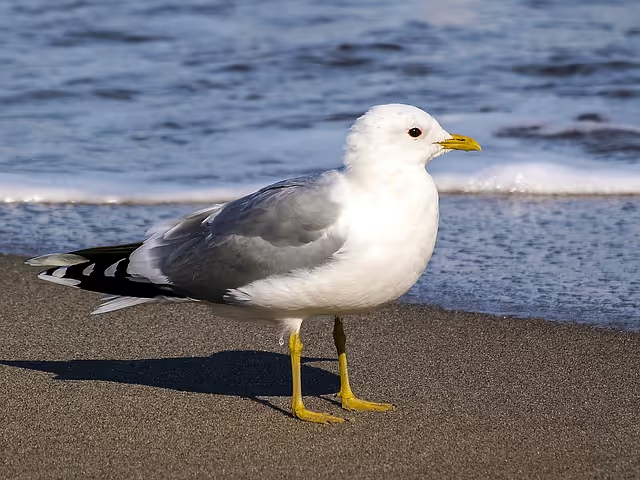
Short-Billed Gulls have white heads and black wingtips. On the surface, they resemble many other species that have these same features, including the California, Iceland, and Ring-billed species. However, upon closer inspection, you will find that Short-Billed Gulls are noticeably smaller. They have thin, small, delicate bills, as well as round heads with dark eyes. These features help to give the species a gentle expression. Additionally, Short-Billed Gulls have short necks and tails, as well as moderately long legs. The birds are generally 16.1 to 18.1 inches (41 to 46 centimeters) long, and weigh 12.7 to 21.2 ounces (360 to 600 grams). Their wingspan is 42.1 to 44.9 inches long (107 to 114 centimeters).
Adult Short-Billed Gulls have two different color plumages. When they are breeding, their backs are medium gray. Their heads and necks are white, as is the area below their backs. Their bills and legs are yellow. When they aren't breeding, the plumage is similar. However, their heads and necks are lightly mottled with a pale brown color. Young gulls are generally brown, with darker flight feathers and blackish tails. During their first winter, young gulls will acquire their gray backs.
Short-Billed Gulls spend the winter months along the coastal waters of North America's west coast starting near the United States/Mexico border, and extending all the way to the Aleutian Islands in Alaska. They tend to concentrate around the mouths of rivers and lagoons. They will also inhabit freshwater ponds that are near the shore. While larger gulls will often spend the winter at landfills gorging themselves on the trash that humans generate, Short-Billed Gulls generally don't engage in this practice. In the summer months, Short-Billed Gulls trade a sizable portion of their coastal winter territory for the many lakes that can be found in the northern forests of Canada and Alaska. They particularly enjoy spending time perched on top of spruce trees.
Short-Billed Gulls forage for food while walking, swimming, or wading. When in flight, they'll dip down to the surface of the water if they find something to eat. Their coastal (winter) diet mostly consists of small fish, while their inland lakes (summer) diet is primarily insects. They will also eat crustaceans, sea urchins, earthworms, and small rodents. In late summer, they add many berries to their diet. If they find a hard-shelled mollusk to eat, they will sometimes carry it up into the air and drop them down onto rocks to break them open. They also try catching flying insects in the air from time to time. Short-Billed Gulls generally forage in flocks, and are often mixed in with other seabird species when doing so. Foraging normally takes place along coastlines, in marine waters that are close to the shore, and in lakes, mudflats, fields, and rivers. They don't tend to stray far out into the waters of the Pacific, and can occasionally be found in inland areas during the winter.
Short-Billed Gulls breed in isolated pairs or small colonies. In courtship, females approach males, who hold sections of territory, in a hunched posture, wagging their heads from side to side to attract attention. Once pairs and colonies are formed, nest sites are chosen. These are normally either on high ground near a body of water, or on top of a stump or dense low spruce tree up to twenty feet above the ground. Ground nests are grass-lined shallow scrapes, while tree nests are either platforms or shallow cups of grasses and twigs. Males and females work together to build the nest, in which three eggs will normally be laid (sometimes only two eggs are laid). The eggs are olive to buff in color, and have brown blotches on them. The incubation process is handled by both males and females, and takes twenty-three to twenty-eight days to complete. After the young hatch, they may leave their ground nests within a few days, but won't stray too far. Their parents share feeding responsibilities. Young Short-Billed Gulls make their first flights at about five weeks of age.
References
© Ian D. Caldwell, October 2021
Touch whale bones, examine shipwreck artifacts and connect with the coast's living history.

Support our mission, get involved in educational programs, or contribute through donations and volunteering.