• Skip to primary navigation
  • Skip to main content
  • Skip to primary sidebar
  • Skip to footer
Coastal Interpretive Center Logo

Coastal Interpretive Center

  • Home
  • EXHIBITS
    • Indoor Exhibits
      • Olympic Coast National Marine Sanctuary
      • Children’s Exhibit
      • Coastal Watersheds Exhibit
      • Earth Sciences Exhibit
      • Habitat Wing
      • Beachcombing Exhibit
      • Logging on the WA Coast
      • Quinault Indian Nation
      • Ocean Shores History
      • Shipwrecks
      • Whales, Dolphins & Porpoises
    • Outdoor Exhibits
      • Gardens
      • Ocean Shores History
      • Whaling
      • Shipwrecks
      • FADs
      • Trails
    • High Dunes Trail
      • Dune Ecosystems and Communities
      • High Dune Biodiversity
      • High Dune Wetlands
      • High Dune Wildlife
      • Invasive Species in the High Dunes
      • Coastal Sand Dunes
  • RESOURCES
    • Education Programs Catalog
    • Activities For Kids
    • Glimpses Lecture Series
    • Videos
      • Book Reviews
      • Exploring the Washington Coast
      • Family Crafts and Education
      • Winged Wonders
    • Coastal Glimpses Newsletter Archive
    • Ocean Shores
    • Ocean Shores History Comes Alive!
  • BLOG
  • ABOUT
    • CENTER TEAM
    • CENTER HISTORY
    • CENTER INFORMATION
    • State of the Museum
    • Bookstore
    • Careers
    • Frequently Asked Questions
    • Raves
  • Events
    • Event Calendar
  • Contribute
    • Membership
    • Sand Dollar Society
    • Donate
    • Volunteer
  • Contact

The Sam’s River Loop Trail

June 6, 2022 by Larry Workman

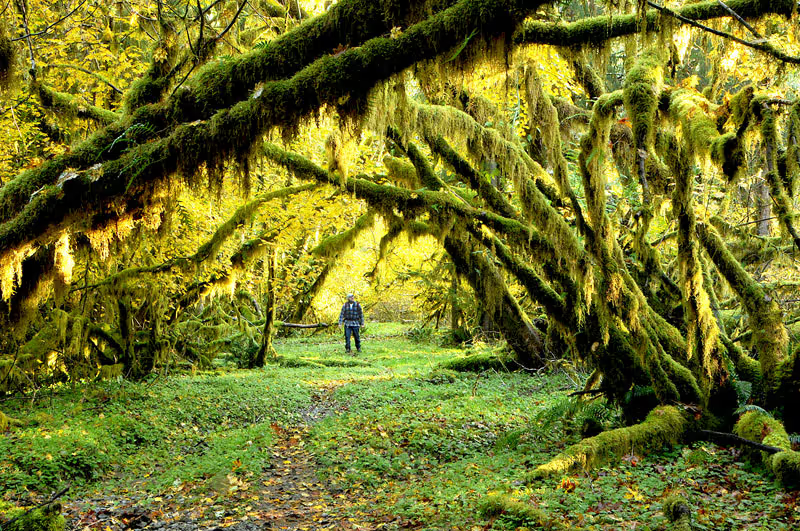
The Sam’s River Loop explores a rich bottomland ecosystem in the Queets Rainforest. It’s a great choice for families, and alternative to the Queets River Trail when the river ford is not possible. Visitors will enjoy active wildlife, level grades and light crowds in the Park’s most remote and primitive rainforest.

The trail begins on a high bank just above the Queets – Sam’s River confluence. Here you can see the Queets River Trail marked by an orange symbol on the far bank, and sense for the difficult ford required to reach it.

The Sam’s River Trail curls into a lush mix of bigleaf maple, vine maple, hemlock and Sitka spruce. Large elk herds frequent this area, and their regular browsing has created an open (and even manicured) feel in places.

The trail emerges in a large meadow once homesteaded that is now frequented by elk (.95 miles : 295′). It enters a thick hemlock forest (1.3 miles) and emerges on the trailhead access road at the Queets Ranger Station (1.55 miles).

Walk toward the Ranger Station (seasonally staffed) and follow signs for the trail. This section leads to a high bank over the Queets River with good views and improvisational access.

It follows the river closely before rejoining the road (1.7 miles), which you’ll take back to the parking area to complete the loop (2.95 miles).

Open year round except during wind storms. No fee.

Getting there:

From Amanda Park take U.S. 101 North for 10.6 miles, then turn right at the Upper Queets entrance to Olympic National Park. Follow USFS 21, also called West Boundary Road, for 6 miles, following the signs.

Turn right at the bottom of the decent into the Queets Valley and drive just past the campground to the end of the road.

Did you know?

Olympic National Park’s rainforests produce more biomass (living or once living matter) than tropical rainforests.


© Larry Workman, May 2022

This article was originally published in the May 2022 edition of the Nugguam. Shared with the  permission of the author.

Category iconHiking Trails Tag iconCoastal Forests,  Elk,  Hiking Trails,  Rivers,  Trails

Primary Sidebar

Hey, Did You Know?

  • The Pacific Tree Frog: Part 2
  • The Pacific Tree Frog: Part 1
  • Bigleaf Maple

Follow CIC

  • Email
  • Facebook
  • Instagram
  • Phone
  • Twitter
  • YouTube

Categories

Tags

Beachcombing Bears Birds Bird Watching Black Bears Botanical Botany Cats Coastal Watersheds Cougars Ducks Flowers Gardening Geology Gulls Hummingbirds Invasive Species Large Mammals Life Cycle Lions Mammals Marine Life Migratory Birds Mountain Lions Native Plants Native Species Nature Oceans Ocean Shores Ocean Shores History Olympic Peninsula Pacific Coast Pacific Northwest Pacific Ocean Plants Pumas Sea Stars Shrubs Songbirds Spring Trees Waterfowl Weather Wildlife Winter

Footer

EXPLORE OUR BLOG

  • The Pacific Tree Frog: Part 2
  • The Pacific Tree Frog: Part 1
  • Bigleaf Maple

FIND US

1033 Catala Ave SE,
Ocean Shores, WA 98569
360-289-4617

Hours: Saturday and Sunday, 10:00am to 4:00pm
Closed Monday - Friday


Terms and Conditions of Use / Privacy Policy

© 2022 Coastal Interpretive Center

FOLLOW CIC

  • Email
  • Facebook
  • Instagram
  • Phone
  • Twitter
  • YouTube

SIGN UP FOR OUR NEWSLETTER

The Skulls & Evolution Exhibit features a selection of skulls from animals native to the Washington Coast. Discover how these animals relate to one another and how functions like eating affect shape their skull structure.

This Exhibit will be on display through January 28, 2024.