Nature
The Native Pacific Dogwood
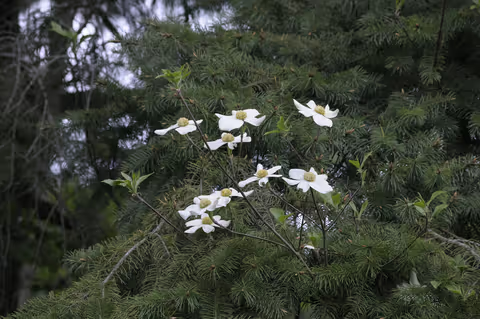
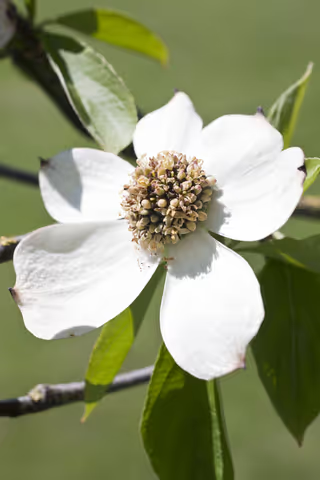
Every region on Earth has plants are native to that particular region, and the Pacific Northwest is no exception. One unique plant that is native to our little corner of the world is the Pacific Dogwood (scientific name: Cornus nuttallii). The Pacific Dogwood is a flowering shrub or tree (it can grow in either form) that grow at the edges of forests up and down the west coast. They particularly like open to dense mixed forest environments located along streams at long elevations. They grow anywhere from two to twenty meters (6.5 to 65.5 feet). They have large "showy flowers". Why is flowers in quotes? That’s because they don't really produce flowers. They just happen to look like flowers. In reality, they are "off white modified leaves" known as bracts. They also produce a cluster of red and orange colored fruits called drupes. Drupes are similar to berries. The Pacific Dogwood normally blooms in the early spring months, so it should be in bloom right now. If not, don't fret. They bloom again in the fall.
The Pacific Dogwood is a deciduous, multi-branched plant with a canopy spread of 20 feet (6.1 meters). The plant's young bark is thin and smooth, but ridges develop as it ages. This makes the trunk appear "scale like". The diameter of a Pacific Dogwood can be as large as 24 inches (61 centimeters). The root system, which is most commonly a taproot, penetrates deeply into the ground. When it is grown under a canopy of vegetation, the Pacific Dogwood's trunk is generally tapered with a short, slender crown. However, when it is grown under a sparse canopy or out in the open, the trunk is most often shorter. The rounded crown can be as tall as it is wide. Pacific Dogwood branches have fine hairs and sport basic, opposite leaves that are 2 to 5 inches (5.1 to 12.7 centimeters) long by 1.5 to 2.8 inches (3.8 to 7.1 centimeters) wide. The leaves are hairier on their undersides, but have stiff, "appressed" hairs above.
The Pacific Dogwood is a sub canopy species. As a result, it has several shade growing adaptations. At a third of full sunlight, it maintains maximum photosynthetic potential. The branches are "self shading", as the leaf petioles "orient downward". This allows the leaves to rest on the branches, thereby shading them. Although the trunk of Pacific Dogwood can occasionally be damaged by direct sunlight, established plants may be able to initiate new shoot growth from the crown to shade and provide protection to the exposed trunk. Although it is typically considered to be a mesic species (meaning it requires a moderate amount of moisture), the Pacific Dogwood is able to tolerate droughts quite well.
Throughout history, Native American tribes have used many parts of the Pacific Dogwood for various reasons. Nlaka`pamux used the bark to make a brown dye. Other Pacific Coastal tribes used the bark as a blood purifier and lung enhancement (it helped when people took long hikes). They also used it to treat stomach ailments. It has been suggested that the bark was used to cure malaria. When it was boiled, it may have had laxative properties. Tribes in the Skagit Valley used the wood from the Pacific Dogwood to make fishing harpoons, games, arrows, and bows.
The Pacific Dogwood is a plant that our friends in the animal world like very much. Deer and elk eat the tree's leaves as forage from time to time. The drupes and seeds are consumed by birds and small mammals, especially by pileated woodpeckers and band tailed pigeons. Depending on the form it grows in, the Pacific Dogwood can provide different habitats for animals. They offer nesting sites and shady spots for critters to occupy. And the bracts provide nectar for pollinators.
The Pacific Dogwood is one of many special plants that are native to the Pacific Northwest. You can find a complete list here: https://www.wnps.org/native-plant-directory
While any time is a great time to celebrate native plants, now is particularly good, because April is Native Plant Appreciation Month. According to the Washington Native Plant Society, the purpose of Native Plant Appreciation Month is…
To Educate people across Washington State to the beauty and importance of our state's native flora and it's relationship to our native pollinators, our wildlife, and ultimately, ourselves.
The goals of the month are to develop peoples' appreciation of native plants and to encourage advocacy for their protection at the grassroots level. You can learn more about you can take part in this special month here. https://www.wnps.org/wnps-annual-events/npam
References
© Ian D. Caldwell, April 2021
Touch whale bones, examine shipwreck artifacts and connect with the coast's living history.

Support our mission, get involved in educational programs, or contribute through donations and volunteering.