Plants
The Kinnikinnick
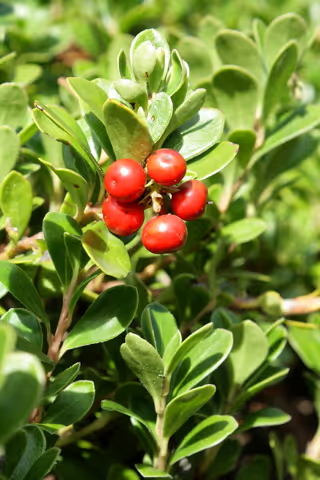

Does your yard have a place that you just can't bring yourself to mow? Do you have a dull parking strip that could use a little color? How about a rockery or retaining wall that could be brightened up with a green plant that produces pink blossoms and red berries? If you answered yes to any of these questions, then we have the perfect plant for you! Say hello to the Kinnikinnick!
The Kinnikinnick is a beautiful plant that will add some color and charm to those annoying and dull parts of your yard, while also making life easier for you. How, you may ask? Well, it is a low maintenance plant, meaning you won't have to do much to take care of it. It is also drought tolerant after its first two dry seasons. While you'll need to water it regularly during its first pair of dry seasons, you won't need to do so as often starting with its third dry season. The Kinnikinnick will also make your yard more lively with birds and insects stopping by to feed on the plant.
The Kinnikinnick is a mat-forming shrub with glossy leaves that retain their green color all year long. It has reddish-brown branches that are six to eight inches tall with a woody texture. It produces beautiful red berries each year in the month of July, and, unlike other berry growing plants here in the Pacific Northwest, they stick around well into February. In the spring, the berries are replaced by pinkish bunches of hanging flowers that are shaped like bells. The Kinnikinnick is happiest in areas that have dry soils and are either partially shaded or full sun. It can tolerate heavier soils and some shade, if necessary. It does not need to be fertilized, and the soil does not need to be compacted around the plants. The Kinnikinnick is not an aggressive plant. It can only grow up to fifteen feet, so you shouldn't have to worry about it taking over your entire yard. It is a member of the Ericaceae (Heath) family.
Kinnikinnick is an Algonquian word that refers to use of dried leaves in smoking mixtures that served as alternatives to tobacco. These mixtures had a number of medicinal uses, one of which is alleged to be the control of several sexually transmitted diseases. The Haida people used it as a diuretic for urinary tract infections and kidney diseases. The dried leaves of the Kinnikinnick can be steeped in boiling water to make an astringent tea, which was used a laxative. The Okanogan-Colville people cooked the berries with salmon or venison or salmon. They also dried them into cakes, and ate the cakes with salmon eggs. In California, various indigenous groups used the berries to produce a cider-like beverage.
Kinnikinnick is not the only name for this plant species. It has several other names, most of which refer to the berries it produces each year. In Greek, Kinnikinnick is known as Arctostaphylos, which means "bear grapes". In Latin, it is known as uva-ursi, which also means "bear grapes." Arctostaphylos and uva-ursi come together to form the plant's scientific name: Arctostaphylos uva-ursi. In Spanish, the Kinnikinnick is known as Manzanita, which means "little apple". One final name is mealberry, which refers to the berries' texture and poor taste when eaten raw. To be tasty, they have to be cooked, either by stewing or frying them. Kinnikinnick itself is a fun word to say because it is pretty close to being a palindrome, meaning that it almost reads the same backwards as forwards.
If you want some Kinnikinnick in the wild before deciding if its right for your yard, you shouldn't have to go too far. It can be found in areas from as low as along the sea to as high as the subalpine zones in the Olympic and Cascade mountain ranges. Sandy slopes, coniferous forests, exposed rocky banks, and dry mountain meadows are all places where this delightful plant can be found.
References
© Ian D. Caldwell, June 2021
Touch whale bones, examine shipwreck artifacts and connect with the coast's living history.

Support our mission, get involved in educational programs, or contribute through donations and volunteering.