Marine Life
Sunfish

Sunfish, also known as Mola Mola, are some of the world's most attractive and mysterious creatures. Part of their appeal is their unusual shape. Sunfish are the heaviest bony fish on Earth. They can grow to more than 10 feet long, and weigh up to 5,000 pounds. National Geographic describes the Sunfish's shape as being "bullet-like" because they are born with a back fin that never grows. Instead, as the Sunfish matures, it folds into itself. This creates a rounded rudder known as a clavus. Sunfish are silvery in color, and their skin texture is rough. They do not have a real tail. Instead, they use their powerful dorsal and anal fins to swim.
Very little is known about the Sunfish's biology and behavior. It was only recently that scientists learned which baby larve turn into the giant creatures. A sunfish's offspring do not look anything like their adult form. Dr. Marianne Nyegaard, the lead scientist on the sunfish discovery from the Auckland War Memorial Museum in New Zealand, compared the larve to the shape of a Pokémon. What's even stranger is that the larvae are rarely ever found. Dr. Nyegaard was quoted by the Sydney Morning Herald newspaper as saying that she and her team "don't understand that because the adults are super fecund." While the larve may not be found very often, there are many of them out there. A 1.5 meter long female can produce a whopping 300 million ova in a single season. So where are they? That is a good question. Adult Sunfish are typically found in temperate and tropical ocean waters, so they would be the first places to look. However, one possible reason why they might be difficult to find is because they are very small. Larve are typically only one-tenth of an inch long. In oceans filled with many other creatures and objects, they might not stand out enough to be spotted. But once they grow into adults, they are hard to miss.
Sunfish first emerged between 35 and 45 million years ago. At the time, whales had legs. A group of puffer fishes left coral reefs for the open ocean. Over time, their bodies became more "abridged". However, they never became as streamlined as other deep sea residents. Tierney Thys, a California based researcher told Smithsonian that the creatures couldn't completely divorce themselves from their bloodlines. Thys summed it up this way. “If your grandmother had a big bottom and your mother had a big bottom, you are most likely going to have a big bottom. There is not much you can do!” Thys compared Sunfish to “big, slobbery Labradors.” The reason for that is because they are covered in both mucus and parasites. Generally, fish are only covered in the latter.
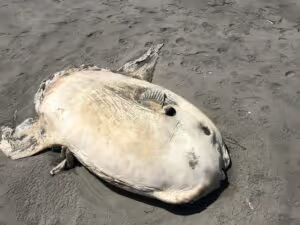
Recently, a Sunfish washed up on the beach in Ocean Shores. It was a quite a sight because of its impressive size. However, it was also unusual because Sunfish don't normally venture this far up the Pacific coast. The reason for that is because they need warm water to survive. If they spend too much time in cold water, they won't survive. That is most likely how the Sunfish ended up on the beach in Ocean Shores. While it cannot be said for certain how the Sunfish got here, I would like to propose the following theory:
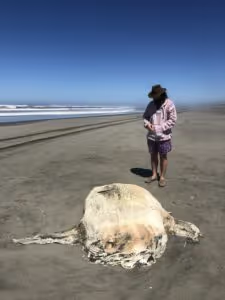
I believe that the Sunfish was migrating north from the warmer waters off the coast of Mexico and Southern California to spend the warm weather months farther north, perhaps around San Francisco. However, it apparently ventured too far into cold water, and got cold-stunned, which is a form of hypothermia. Once it had contracted hypothermia, it was too late for the Sunfish to turn back. I am basing this theory on a similar scenario that plays out on Cape Cod every year. According to capecod.com, upwards of 20-40 Sunfish get stranded in Cape Cod Bay annually. They become stranded due to the challenging geography of the bay. It is difficult for them to get out of there once they get in because of the bay's shallow waters. While the bay is warm enough for the Sunfish in the summer, it gets too cold in the winter. Once they become stranded, they will eventually get cold-stunned and wash up on the beaches there. It is worth noting that the waters of the Atlantic Ocean and the waterways that feed into it, including Cape Cod Bay, are warm enough for Sunfish to live, even as far as north as Cape Cod is.
References
© Ian D. Caldwell, August 2020
Touch whale bones, examine shipwreck artifacts and connect with the coast's living history.

Support our mission, get involved in educational programs, or contribute through donations and volunteering.