Birds
Steller's Jays
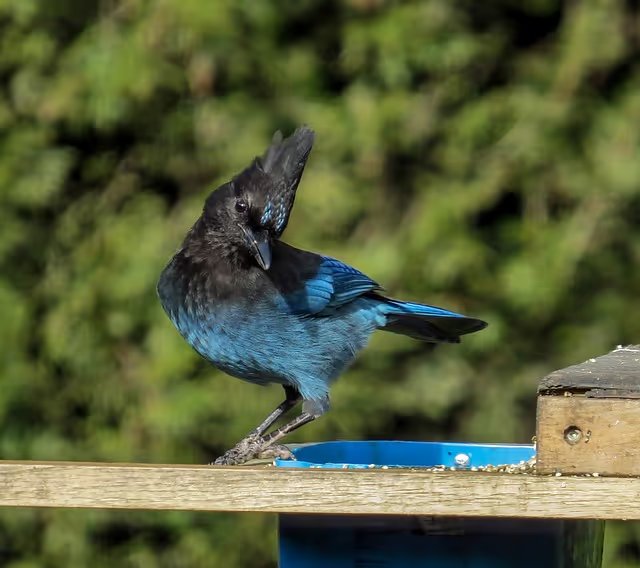

Steller's Jays are a common sight in the forests of the Western United States. They love the dense, coniferous woods of the various mountain ranges in the West, and along the coast of the Pacific Northwest. They love these areas because their dark colors blend in quite well in the shadows cast by the trees. This makes them harder to spot by hunting predators. Steller's Jays are often year-round residents of the places they choose to call home. However, they can move to lower elevations during the winter months when their beloved mountains become covered in deep snow. While they mostly enjoy deep forests, Steller's Jays will venture into more open forests, such as orchards and forested cities and towns. With that said, during their nesting season, they mainly stick to the deep forests and high mountains. Steller's Jays spend most of their time living in flocks, but break off into pairs for the nesting season. The scientific name for Steller's Jays is Cyanocitta stelleri, and they belong to the Corvidae family, alongside other Jays, Magpies, and Crows.
Steller's Jays mostly forage for food on the higher branches of trees. However, they don't limit themselves to those high branches, and will search lower branches of trees or on the ground, if needed. Their diet is a blend of vegetable matter and meat from animals. Approximately two-thirds of their diet comes from vegetable matter, with the remaining one-third coming from animal matter. They feed heavily acorns, pine seeds, and other seeds and nuts throughout the year, but particularly in the fall and winter months. With large nuts, they will typically carry several at a time in their throat and mouth, before burying them one at a time to store for the winter. They open the acorns and hard seeds they find by pounding on them with their bills. Steller's Jays also consume many wild fruits and berries. They will also eat cultivated fruit. In addition, they enjoy eating beetles, wild bees, wasps, spiders, and bird's eggs. In addition, Steller’s Jays are opportunists, and will not hesitate to steal food from other birds or beg people for handouts.
When they are in courtship, a male Steller's Jay will feed the female Steller's Jay. While they are normally quiet while nesting, if their nest comes under threat, they will get aggressive and noisy. They typically build their nests in coniferous trees, but will occasionally opt for shrubs or deciduous trees. They generally build the nest anywhere from ten to thirty feet above the ground, and work together during the construction process. When its complete, the nest is a "bulky ragged cup of twigs, weeds, moss, dry leaves, cemented together with mud and lined with fine grass, rootlets, and pine needles." Additionally, bits of paper are routinely added to the nest.
A typical Steller's Jay pairing will lay anywhere from two to six eggs. The eggs are pale blue-green in color, with fine spots of olive or brown also featured. The incubation process is largely handled by the female, and lasts for approximately sixteen to eighteen days. After the nestlings hatch, both parents go out foraging for food to bring home for their young. It is not well known exactly how young the nestlings are when they take their first flights. However, The Audubon Society believes that it occurs roughly when the birds are just three weeks old.
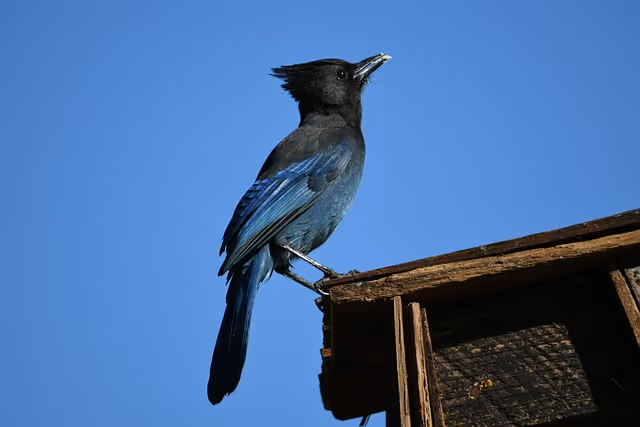
Steller’s Jays are large songbirds. They have chunky bodies, rounded wings, large heads, and a long tail. Their bills are straight and long with a slight hook. In addition, they have a notable triangular crest that typically stands almost straight up from their heads. Steller's Jays don't vary too much in size. They are typically 11.8 to 13.4 inches (30 to 34 centimeters) in length with a 17.3 inch (44 centimeter) wingspan. They weigh anywhere from 3.5 to 4.9 ounces (100 to 140 grams).
From a distance, Steller’s Jays are particularly dark Jays as they lack the white underparts of most other species of Jays. Their heads are charcoal black in color, and their bodies are varying shades of blue. In addition, they have "inconspicuous" white markings above their eye. Like other Jays, Steller’s Jays are intelligent, inquisitive, noisy, and bold. They spend the majority of their time exploring the forest canopy, coming down to the forest floor to look for food or investigate visitors to their territory. While on the ground, they move by hopping on their long legs in a "decisive" manner.
References
© Ian D. Caldwell, October 2020
Touch whale bones, examine shipwreck artifacts and connect with the coast's living history.

Support our mission, get involved in educational programs, or contribute through donations and volunteering.