Wildlife
Squirrel or Chipmunk?
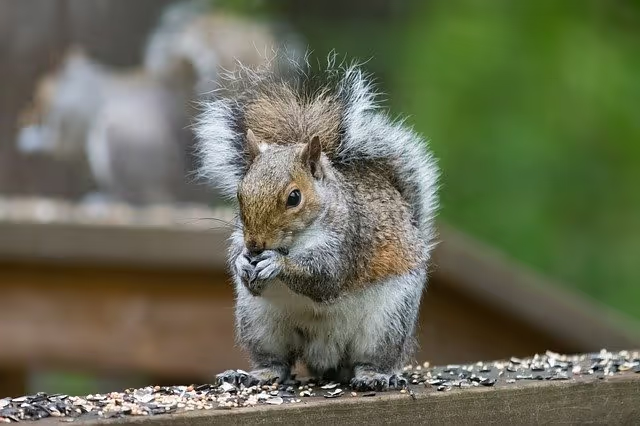
I overhead a heated exchange between two youngsters…
“It’s a squirrel!”
“Naw, it’s a chipmunk!”
Since I was the only tall person around, they looked to me to solve the argument. I didn’t know the answer. Perhaps you would?
What ARE the main differences between squirrels and chipmunks?
I looked to the Northwest Regional Gap Analysis Project (NWGAP), site info at https://lemma.forestry.oregonstate.edu/projects/gap, which maps and assesses biodiversity within Washington, Idaho, Oregon, Montana, and Wyoming. It lists five squirrels and chipmunks breeding in Grays Harbor County.
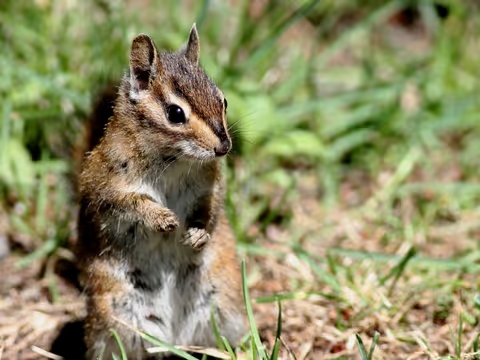
TOWNSEND’S CHIPMUNK (Neotamias townsendii) is one of the two most common chipmunks in our county. Its fur has an overall reddish mahogany color. The stripes are deep brown alternating with tan. For a chipmunk, it’s large, often 14” from tail to nose. Active all year in our mild climate, it is an omnivore and eats a variety of foods including plants and insects. It can also eat bird eggs!
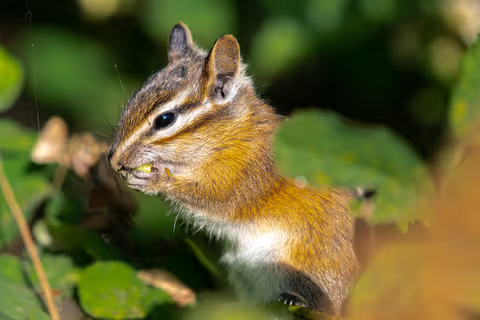
YELLOW-PINE CHIPMUNK (Neotamias amoenun) has five long dark-colored body stripes alternating with four light-colored stripes. The outer two stripes are almost white, and the two inner stripes are grayer. Two of the five head stripes on either side are very white. This chipmunk is among the smaller chipmunks at only 7-9” long. As an omnivore, it isn’t fussy about what it eats! The ears are large, dark in front and white in the back. Both sexes hibernate after storing seed to eat the following spring.
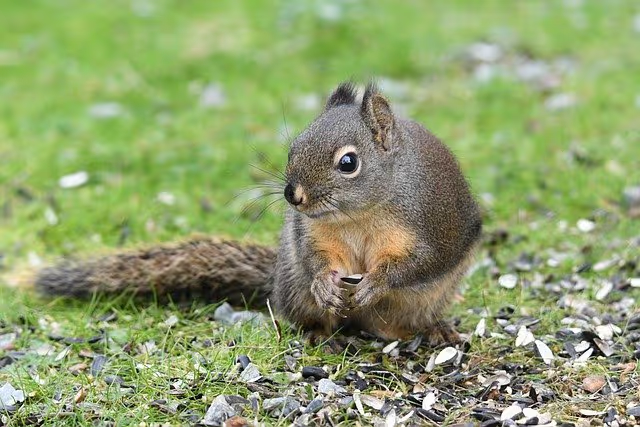
DOUGLAS SQUIRREL (Tamiasciurus douglasii) body color is an overall red or brown grey fading into a reddish brown in the middle of the back. This may fade to a greyer winter color. One identifying feature is the small ear tufts appearing in the winter. Including the 5-7” bushy tail, the overall size is 10 -14”. The habitat is the coniferous forest and it’s usually found on the ground eating seeds from conifers such as Douglas Fir, Sitka Spruce, and Shore Pine. They store green cones and nuts to eat during the winter. This squirrel is the “noisiest squirrel” by making warning calls to other animals.
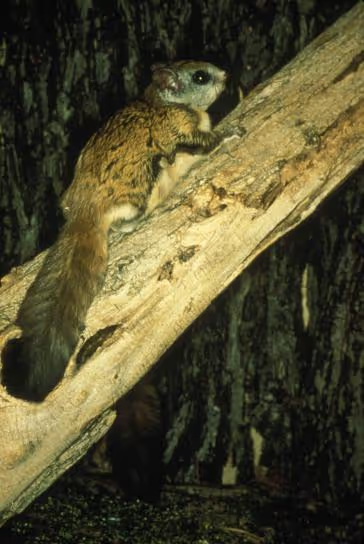
NORTHERN FLYING SQUIRREL (Glaucomys sabrinus) at only 10-12” in total length is the smallest tree squirrel in Washington. Two unique features are its wide flat tail and large dark eyes. This adaptation is useful as it is a nocturnal animal, gliding in its dark forest environment. Its coloring is a creamy light underbelly and medium brown or dark grey back. Another omnivore, these squirrels eat insects, carrion, eggs, baby birds, tree sap and fungi. (See blog post on Flying Squirrels)
WESTERN GRAY SQUIRREL (Sciurus griseus)is the largest tree squirrel in the Pacific Northwest. Its body is approximately 12” long with a matching length bushy tail carried upwards in an “S” shape. Unlike the invasive Eastern Gray Squirrel, our native Western Gray Squirrel’s coat is “counter shaded” with true gray with a white underbelly and white edged tail. The Western Gray Squirrel is shy and generally runs up a tree while chirping hoarsely when frightened. Urban development and other species such as the Eastern Gray Squirrel threatens the habitat of the less adaptable Western Gray Squirrel.
So, now you know about chipmunks and squirrels. The next time you hear the chipmunk/squirrel dispute, you’ll be able to smile because you know the difference!
© Jacqui Austin, April 2021
Touch whale bones, examine shipwreck artifacts and connect with the coast's living history.

Support our mission, get involved in educational programs, or contribute through donations and volunteering.