Marine Life
Shortfin Mako Sharks
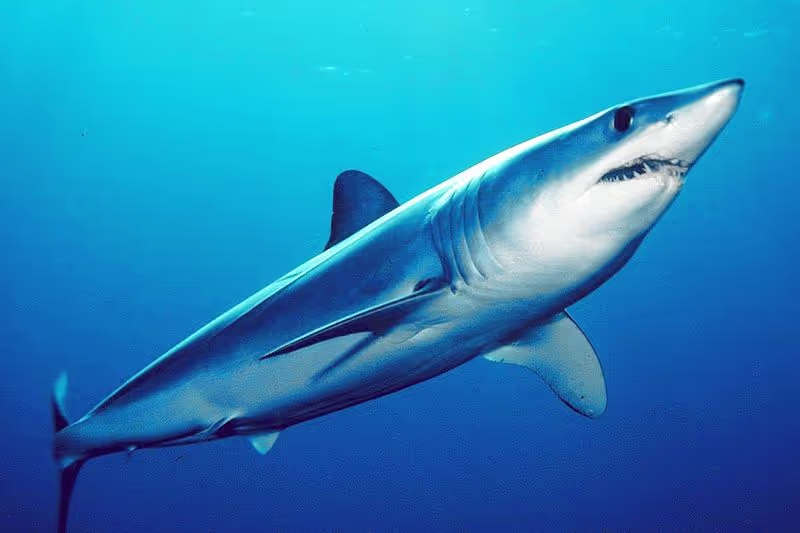
Shortfin mako sharks (Isurus oxyrinchus) can be found all over the world in tropical and temperate waters. In the eastern Pacific Ocean, they range from southern Washington to Chile. The Southern California Bight is noted to be an important habitat for juveniles.
They can be found in pelagic (open ocean) environments to depths of up to 2428 feet (740 meters), though they typically spend most of their time in surface waters up to 328 feet (100 meters) deep (petition). They can be found in both nearshore and offshore environments.
They get the name “shortfin” from their pectoral fins, which are shorter than the lengths of their heads. Their heads are conical shaped and they have large eyes. Their first dorsal fin is large while their second dorsal and anal fins are much smaller (Defenders of Wildlife 2021). Their caudal, or tail fin is crescent-shaped.
Shortfin makos have dark blue coloration on their dorsal side and white on their ventral side. They are born around 28 inches (71 centimeters) in length and can grow to a maximum of 13 feet (4 meters).
Shortfin mako sharks are the fastest sharks in the world, capable of travelling speeds up to 45 miles per hour (74 kilometers). They are highly migratory and are capable of travelling distances of 1300 miles (2092 kilometers) in a little over a month (MarineBio 2023).
Shortfin makos feed on fishes, such as tuna and swordfish, and squid. Larger adults also prey upon marine mammals such as seals and sea lions. As they are apex predators, not many species prey upon shortfin makos, though larger sharks and orcas have been known to prey upon juvenile shortfins.
Male shortfin makos reach reproductive age at about 9 years old while females do not reach it until they are about 18 years old. They are sexually dimorphic with the females being larger than the males. They have a three-year reproductive cycle including a 15-18 month gestation period. Eggs are fertilized inside the body and pups are born live. Litter size is 4-15 pups. Shortfin makos live to about 30 years of age.
In January 2021, there was a petition to list the shortfin mako as a threatened or endangered species under the Endangered Species Act. In November 2022, NOAA determined federal listing to not be warranted at this time. However, they are still listed as Endangered by the International Union for the Conservation of Nature (IUCN) and Atlantic populations, which have seen the steepest declines in recent years, are currently under a fishing ban.
References
California Department of Fish and Wildlife. (2020, October 8). Shortfin Mako Shark. CA Marine Species Portal. https://marinespecies.wildlife.ca.gov/shortfin-mako-shark/false/
Defenders of Wildlife. (2021, January 25). Petition to List the Shortfin Mako Shark (Isurus oxyrinchus) as Endangered or Threatened Under the Endangered Species Act. National Oceanic and Atmospheric Administration. https://media.fisheries.noaa.gov/2021-01/Shortfin-Mako-Shark-Petition-508.pdf?null=
MarineBio Conservation Society. (2023, July 12). Shortfin Mako Sharks. MarineBio Conservation Society. https://www.marinebio.org/species/shortfin-mako-sharks/isurus-oxyrinchus/
NOAA. (2022, November 14). 12-month finding on a petition to list the shortfin mako shark under the Endangered Species Act. National Oceanic and Atmospheric Administration. https://www.federalregister.gov/documents/2022/11/14/2022-24493/endangered-and-threatened-wildlife-and-plants-12-month-finding-on-a-petition-to-list-the-shortfin
Pacoureau, N., Sherley, R., Liu, K.-M., Barreto , R., Fernando, D., Romanov, E., Rigby, C., Winker, H., Carlson, J., Marshall , A., Francis , M., Jabado , R., & Fordham , S. (2018, November 5). Shortfin Mako. IUCN Red List of Threatened Species. https://www.iucnredlist.org/species/39341/2903170
Photo Credit: Mark Conlin, NOAA SWFSC Large Pelagics Program
© Laura Caldwell, August 2023
Touch whale bones, examine shipwreck artifacts and connect with the coast's living history.

Support our mission, get involved in educational programs, or contribute through donations and volunteering.