Plants
Seashore Lupine
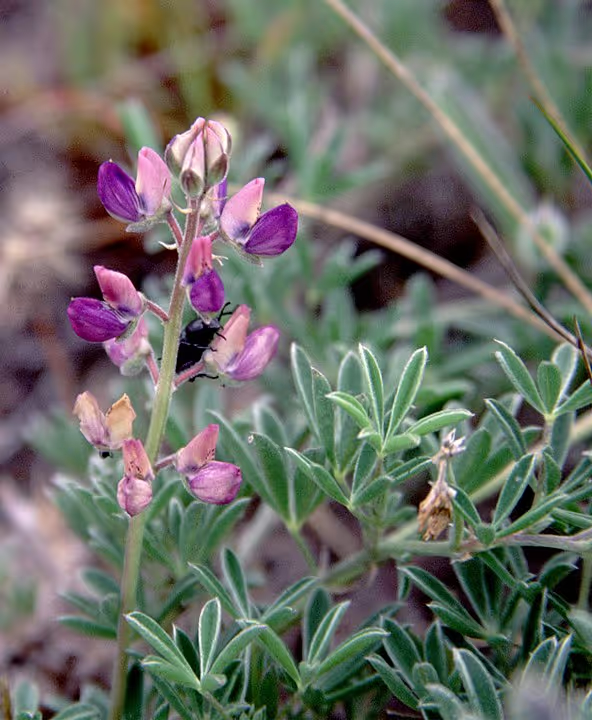
Seashore lupine (Lupinus littoralis) is a member of the Fabaceae (pea) family native to the Pacific coast of North America. This perennial subshrub is native to the Pacific Northwest, growing from British Columbia to northern California in sandy, coastal habitats. In Washington State, it can be found in San Juan, Island, Skagit, and King Counties in addition to the Pacific Coast. It has been observed at several parks in the North Beach area, including Damon Point, Ocean City State Park, and Griffiths-Priday State Park, as well as the Olympic National Park.
Seashore lupine grows in mats of up to 2 square feet and about 1 foot tall (30 cm). Their roots can be up to 3.3 feet (1 m) long and are yellow in color. It is also an atmospheric nitrogen fixer, forming a symbiotic relationship with soil bacteria who live on their roots. As a coastal plant it prefers full sun and sandy soils, though it can grow in moist, well-draining, acidic to neutral soils.
Seashore lupine is a pioneer species. As it can tolerate poor soils, it is one of the first plants to grow in a disturbed site and because it improves the soil throughout its life, it paves the way for more permanent vegetation to thrive once it dies out. Because of this and its large roots, it can be a good choice for dune stabilization projects.
The leaves are palmate, meaning they contain several leaflets radiating from a central point. In seashore lupine’s case, they contain 5 to 9 leaflets up to 1.4 inches (3.5 cm) long with long silver hairs. The leaves are oblong-shaped with a pointed tip.
Flowers range from white to purplish-blue in color and are each about 0.4 inches (1 cm) long. They are typical to other flowers in the Fabaceae family. The flowers are arranged in whorls around a 5-6 inch (12.7-15.25 cm) flower spike, which in turn is located on a 1-3 inch (2.5-7.6 cm) stalk. The plant blooms from about May to August.
Seashore lupine plants are hermaphrodites and are pollinated by bees. Seed pods appear from about July to October. They can grow up to 1.5 inches (4 cm) long and are covered in hair. The pods contain up to 12 seeds which are a gray mottled color. Seashore lupine is best propagated from seed, though they can also be propagated from basal cuttings. They are capable of hybridizing with other lupine species, such as Lupinus arboreus, in the wild.
Seashore lupine roots are edible to humans both cooked and raw, though they are best eaten cooked as they contain bitter-tasting alkaloids which the cooking process reduces. If consumed raw, they can cause respiratory depression, drowsiness, and convulsions. The roots are rich in starch and have a sweet flavor.
References
Carlson, J., Reckendorf, F., & Ternyik, W. (1991). (publication). Stabilizing Coastal Sand Dunes in the Pacific Northwest. Washington D.C.: United States Department of Agriculture Soil Conservation Service. Retrieved February 14, 2022, from https://search.nal.usda.gov/discovery/delivery/01NAL_INST:MAIN/12285895400007426.
Fern, K. (n.d.). Lupinus littoralis. Useful Temperate Plants. Retrieved February 14, 2022, from http://temperate.theferns.info/plant/Lupinus+littoralis
Klinkenberg, B. (Ed.). (2020). Lupinus littoralis Douglas. E-Flora BC: Electronic Atlas of the Plants of British Columbia. Retrieved February 11, 2022, from http://linnet.geog.ubc.ca/Atlas/Atlas.aspx?sciname=Lupinus+littoralis
Morrison, P.H. and H.M. Smith IV (2007). Rare Plant and Vegetation Survey of Damon Point, Griffith-Priday, Ocean City, and Pacific Beach State Parks. Pacific Biodiversity Institute, Winthrop, Washington. 118 p.
Turner, M. (n.d.). Lupinus littoralis: Seashore lupine. Pacific Northwest Wildflowers. Retrieved February 11, 2022, from https://www.pnwflowers.com/flower/lupinus-littoralis
© Laura Caldwell, February 2022
Touch whale bones, examine shipwreck artifacts and connect with the coast's living history.

Support our mission, get involved in educational programs, or contribute through donations and volunteering.