Pacific Ocean
Sea Star Wasting Syndrome (SSWS)
If you've been following oceanography news in recent years, you've probably heard about sea star wasting syndrome (SSWS). The syndrome has always been present, with sea stars exhibiting similar symptoms being reported as early as 1896, but the most recent outbreak along the Pacific Coast of North America resulted in the largest marine epizootic event ever recorded.
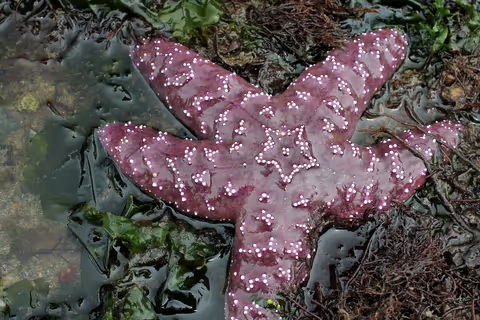
The disease was first observed in June 2013 among ochre sea stars (Pisasterochraceus) in the Olympic National Park. Observations among sea stars in the Salish Sea, California, and British Columbia soon followed. By the spring of 2014, it spread throughout the West Coast from the Gulf of Alaska to Baja California. While mortality rates have subsided, SSWS is still present and many affected species have not recovered to pre-2013 levels.
Sea star populations in Ocean Shores were not immune. In the summer of 2014, Jerry Mergler reported to the North Coast News that not one healthy sea star could be found at Damon Point when the populations were fine mere weeks before.
Symptoms include deflated appearance, unusual arm twisting, white lesions, autotomy (self-amputation), and body disintegration. Once a sea star beings exhibiting symptoms, they can die in a matter of weeks or even days. Recovery is rare.
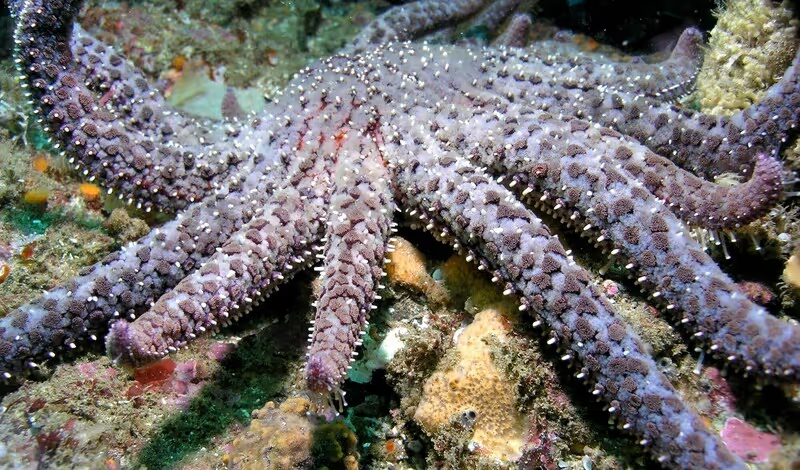
Though it has affected over 20 species of sea star along the Pacific Coast, most of the studies have focused on two: sunflower sea stars (Pycnopodiahelianthoides) and ochre sea stars. The former have been the most severely affected by SSWS, with one study finding a 99.2% population decline in Washington and a 100% decline in Oregon and California (Harvell et al. 2019). This severe decline has led to sunflower sea stars becoming a critically endangered species by IUCN assessment and a rarity along the Washington Coast (Frierson et al. 2020).
Both species are keystone species, which are important to maintaining the health and biodiversity of kelp forests and the rocky intertidal. Without them, species they prey upon such as California mussels and purple sea urchins can become dominant.
The cause of SSWS remains unknown. Early studies suggested the cause was sea star-associated densovirus (SSaDV), though this has since been disproven (Hewson et al. 2014, 2018, 2020). Environmental factors, such as higher water temperature, have also been suggested as a cause. Most recently, it has been suggested that an abundance of bacteria on the surface of the sea star might be causing the stars to suffocate as the bacteria prevent them from receiving the oxygen they need (Aquino et al. 2021). However, this has yet to be definitively proven and much about SSWS still remains a mystery.
References
Aquino, C. A., Besemer, R. M., DeRito, C. M., Kocian, J., Porter, I. R., Raimondi, P. T., Rede, J. E., Schiebelhut, L. M., Sparks, J. P., Wares, J. P., & Hewson, I. (2021). Evidence that microorganisms at the animal-water interface drive sea star wasting disease. Frontiers in Microbiology, 11. https://doi.org/10.3389/fmicb.2020.610009
Frierson, T., Gehman, A., Alvstad , K., Saccomanno , V., Heady , W., Hamilton, S., &Gravem , S. (2020, August 26). The IUCN Red List of Threatened Species. IUCN Red List of Threatened Species. Retrieved May 3, 2022, from https://www.iucnredlist.org/species/178290276/197818455
Harvell, C. D., Montecino-Latorre, D., Caldwell, J. M., Burt, J. M., Bosley, K., Keller, A., Heron, S. F., Salomon, A. K., Lee, L., Pontier, O., Pattengill-Semmens, C., &Gaydos, J. K. (2019). Disease epidemic and a marine heat wave are associated with the Continental-scale collapse of a pivotal predator ( pycnopodia helianthoides ). Science Advances, 5(1). https://doi.org/10.1126/sciadv.aau7042
Hewson, I., Aquino, C. A., &DeRito, C. M. (2020). Virome variation during sea star wasting disease progression in Pisasterochraceus (Asteroidea, echinodermata). Viruses, 12(11), 1332. https://doi.org/10.3390/v12111332
Hewson, I., Bistolas, K. S., QuijanoCardé, E. M., Button, J. B., Foster, P. J., Flanzenbaum, J. M., Kocian, J., & Lewis, C. K. (2018). Investigating the complex association between Viral Ecology, Environment, and Northeast Pacific Sea Star Wasting. Frontiers in Marine Science, 5. https://doi.org/10.3389/fmars.2018.00077
Hewson, I., Button, J. B., Gudenkauf, B. M., Miner, B., Newton, A. L., Gaydos, J. K., Wynne, J., Groves, C. L., Hendler, G., Murray, M., Fradkin, S., Breitbart, M., Fahsbender, E., Lafferty, K. D., Kilpatrick, A. M., Miner, C. M., Raimondi, P., Lahner, L., Friedman, C. S., … Harvell, C. D. (2014). Densovirus associated with sea-star wasting disease and mass mortality. Proceedings of the National Academy of Sciences, 111(48), 17278–17283. https://doi.org/10.1073/pnas.1416625111
Mergler, J. (2014, August 21). Local Report: Sea Stars 'wasting away'. The North Coast News.
Sea star wasting syndrome. MARINe. (2022). Retrieved May 3, 2022, from https://marine.ucsc.edu/data-products/sea-star-wasting/index.html
© Laura Caldwell, May 2022
Touch whale bones, examine shipwreck artifacts and connect with the coast's living history.

Support our mission, get involved in educational programs, or contribute through donations and volunteering.