Marine Life
Salps: A Mystery on the Beach
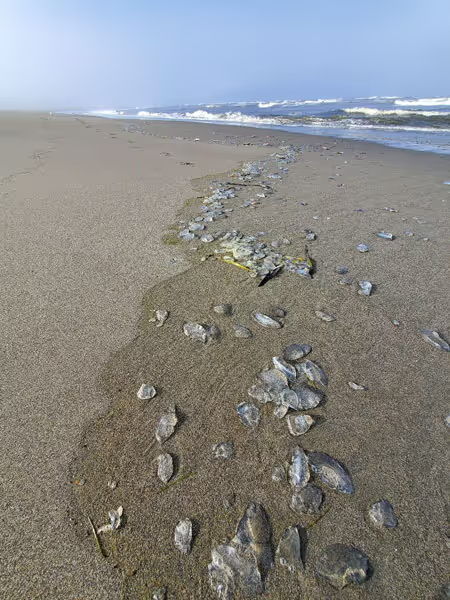
August 3 to August 5, something different from the normal was seen on the beach between Driftwood South and Marine View Drive. The morning tide was bringing a continuous wrack line that looked like jellyfish. The pieces ranged from a centimeter to about 10 centimeters.
What caused this? Since there were several intact jellyfish nearby, we had to wonder if they were possibly pieces of jellyfish that had been shattered by the sonic waves from the 8.2 earthquake on July 29th.
The question was referred to the Invertebrate specialists at the University of Washington through the Coastal Observation and Seabird Survey Team (COASST). The response explained that, although the theory was interesting, the waves would be much too low and slow to cause damage to anything like a jellyfish. They felt these critters were salps.1
We consulted with the Cannon Beach Gazette and the Australian Museum; both generously shared their information.
So what is a salp?2
A salp is a pelagic tunicate, meaning they are tunicates that drift in the mid-water of the ocean. They move by means of jet propulsion and feeding is accomplished by pumping plankton-laden water through the body where a mucous net is used to extract food particles. They can be found individually or in large aggregations consisting of millions of individuals.
They often undergo daily vertical migrations, coming to the surface at night and diving down to over 1600 feet during the day. While salpa fusiformis is typically found offshore, occasional nearshore swarms do occur.
SEA SQUIRTS3
Despite looking rather like a jellyfish, salps are a member of the Tunicata, a group of animals also known as sea squirts. They are related to all the animals with backbones. Larval salps have a notochord running down their back, a tough, flexible rod which protects the central nerve cord and provides an attachment point for muscles. Adults lose their notochord as they grow, but it is one of the ways we can tell that sea squirts are the closest living relatives of the vertebrates.
Salps are semi-transparent barrel-shaped marine animals that move through the water by contracting bands of muscles which ring the body.
When found washed up on the shores, they are often mistaken for jellyfish. The contracting muscles draw water in the front of the test and out the rear. Salps feed by filtering plankton and algae and move using an incredible efficient jet propulsion system, one of the most efficient examples of jet propulsion in the animal kingdom.
Sinking fecal pellets and bodies of salps carry carbon to the sea floor, and salps are abundant enough to have an effect on the ocean’s biological pump. Consequently, large changes in their abundance or distribution may alter the ocean’s carbon cycle and potentially play a role in climate change.
1University of Washington
2Cannon Beach Gazette
3Australian Museum
© Jean Lingg, September 2021
Touch whale bones, examine shipwreck artifacts and connect with the coast's living history.

Support our mission, get involved in educational programs, or contribute through donations and volunteering.