Birds
Ring-billed Gulls
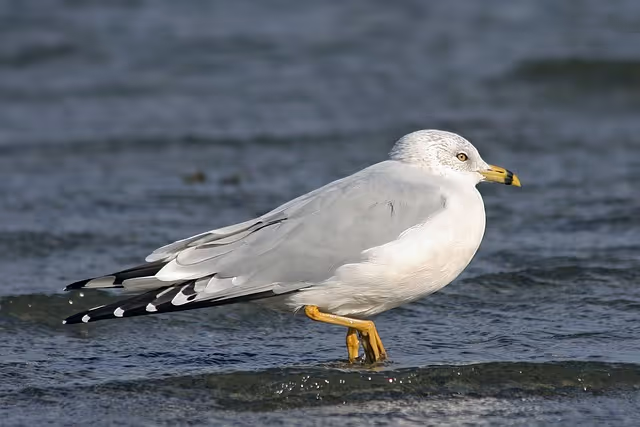
Ring-billed gulls (Larus delawarensis) are a common sight in North America. In fact, these medium-sized gulls are commonly found in the interior of the continent since they nest near freshwater. In Washington, non-breeding gulls are common in western Washington while breeding gulls are common to eastern Washington. They are common year round on the dredge-spoil islands in Grays Harbor and Willapa Bay (Seattle Audubon n.d.).
Ring-billed gulls get their common name from the black ring around their yellow beaks, which is present on both breeding and non-breeding adults. Adults have gray backs and wings with black wingtips spotted with white. Their heads, bodies, and tails are white and their legs and eyes are yellow. Non-breeding adults brown mottling on their heads, but otherwise look the same.
Juveniles lack their namesake ring and instead have pink bill with a black tip. Their legs are also pink. Their plumage is a mottled brown, gray, and white. They change to their adult plumage around two years of age.
Ring-billed gulls can be found in a wide variety of habitats, including coasts, estuaries, mudflats, grasslands, reservoirs, and landfills. While they are usually found near a marine or freshwater environment, they are not found in the open ocean.
Ring-billed gulls are migratory. They typically breed in the northern United States and Canada and winter in the Gulf Coast, Mexico, and Central America. Non-breeding gulls travel in flocks and will often space themselves out evenly (Cornell Lab n.d.). They nest in colonies ranging from 20 to tens of thousands of pairs.
These gulls are quite omnivorous, willing to eat nearly anything that is available to them. They commonly feed on insects, worms, rodents, fish, crabs, and human refuse. They will steal food from other birds and even food left unattended by humans. They may also scavenge foods such as insects, grains, and berries from farmlands.
Ring-billed gulls are ground nesting birds, preferring to nest in sparsely vegetated areas near freshwater. However, nests are usually built near vegetation (BirdLife International 2018). Nests are scrapes in the ground lined with sticks, grasses, leaves, or mosses, though some nests may not have a lining at all. Both parents build the nest, incubate the eggs, and brood the young. Nesting sites will often be reused over multiple breeding seasons.
Laying occurs between April and May. Clutches contain 2-4 eggs incubated over a period of 20-31 days. They are capable of leaving the nest about two days after hatching, but they do not venture very far. They fledge about 5-6 weeks after hatching and reach full maturity at about 2-3 years of age. The oldest ring-billed gull on record is a 28-year-old gull photographed in Cleveland in 2021 (Mandelbaum 2021).
References
BirdLife International. (2018, August 8). Larus delawarensis. IUCN Red List of Threatened Species. Retrieved November 29, 2022, from https://www.iucnredlist.org/species/22694317/132541912
Cornell Lab of Ornithology. (n.d.). Ring-billed gull . All About Birds. Retrieved November 29, 2022, from https://www.allaboutbirds.org/guide/Ring-billed_Gull/overview
Dewey, T., & Pappas, J. (2001). Larus delawarensis. Animal Diversity Web. Retrieved November 29, 2022, from http://www.biokids.umich.edu/critters/Larus_delawarensis/
Kaufman, K. (2022, March 31). Ring-billed gull. Audubon Field Guide. Retrieved November 29, 2022, from https://www.audubon.org/field-guide/bird/ring-billed-gull
Mandelbaum, R. F. (2021, March 23). Oldest ring-billed gull on record discovered by Cleveland Birder. Audubon. Retrieved November 29, 2022, from https://www.audubon.org/news/oldest-ring-billed-gull-record-discovered-cleveland-birder
Seattle Audubon Society. (n.d.). Ring-billed gull. BirdWeb. Retrieved November 29, 2022, from https://www.birdweb.org/birdweb/bird/ring-billed_gull
© Laura Caldwell, November 2022
Touch whale bones, examine shipwreck artifacts and connect with the coast's living history.

Support our mission, get involved in educational programs, or contribute through donations and volunteering.