Crabs
Purple Shore Crabs
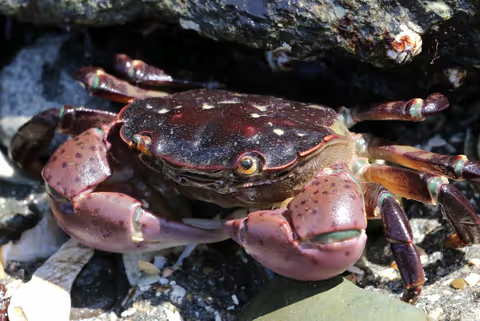
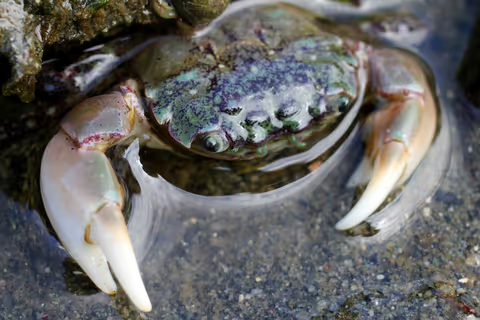
European green crabs continue to threaten the Washington Coast. As of September 4th, a total of 176,600 green crabs have been captured and removed throughout the state in 2022 (WDFW 2022). Despite their threat, the Washington Department of Fish and Wildlife asks that the public not attempt to remove or kill European green crabs as there are many native crab species that can look similar. One of these crabs is the purple shore crab (Hemigrapsus nudus), also referred to as the naked shore crab.
Despite the name, purple shores crabs can be purple, green, or reddish brown. Their claws have purple or reddish spots with white tips. Their carapace can grow up to 2.2 inches (5.6 cm) in males and 1.33 inches (3.4 cm) in females.
The purple shore crab is closely related to the hairy shore crab (Hemigrapsus oregonensis). The two species can be distinguished by setae on their legs, which the hairy shore crab has and the purple shore crab does not. The setae help hairy shore crabs live in environments with low levels of dissolved oxygen. As a result, while hairy shore crabs and purple shore crabs can sometimes be found living in the same area, you will usually find either one or the other (Kozloff 1993).
The purple shore crab can be found from Yakobi Island, Alaska to Bahia de Tortuga, Mexico. They are less common south of Central California. They are intertidal dwellers who prefer rocky coasts or bays and estuaries with large rocks available to use as cover. In areas where they overlap with hairy shore crabs, purple shore crabs can usually be found higher in the intertidal and less likely to be found in muddy substrates (Cowles 2005).
Purple shore crabs feed on diatoms, desmids, green algae. Sometimes they will feed on animals such as amphipods and other crustaceans. They are preyed upon by fish, seabirds, and scoters.
Mating occurs between December and January and hatching occurs between May and July, though these times can vary depending on water temperature (Hiebert 2015). Broods can have up to 36,000 eggs. After hatching, the crabs go through five zoea stages and one megalopa stage before becoming juveniles.
Purple shore crabs can be distinguished from European green crabs by the marginal teeth on their carapace. The purple shore crab has three while the European green crab has five. Purple shore crabs have two rostral bumps compared to the European green crab’s three. Finally, purple shore crabs have a more rectangular-shaped carapace than the European green crab (though not as rectangular as the hairy shore crab).
The Washington Sea Grant Crab Team has extensive ID guides here[go to washington.edu] to help you distinguish European green crabs from purple shore crabs and many other native crab species. If you think you’ve found a European green crab, you can report it to WDFW here[go to wdf.wa.gov] and the Washington Sea Grant Crab Team. But once you’ve taken your photos, it is best to leave the crab alone.
References
Brietzke, C., Fretwell, K., & Starzomski, B. (2016). Purple shore crab . Biodiversity of the Central Coast. Retrieved September 27, 2022, from https://www.centralcoastbiodiversity.org/purple-shore-crab-bull-hemigrapsus-nudus.html
Cowles, D. (2005). Hemigrapsus nudus (Dana, 1851). Invertebrates of the Salish Sea. Retrieved September 27, 2022, from https://inverts.wallawalla.edu/Arthropoda/Crustacea/Malacostraca/Eumalacostraca/Eucarida/Decapoda/Brachyura/Family_Grapsidae/Hemigrapsus_nudus.html
Hiebert, T. C. (2015). Hemigrapsus nudus. Oregon Institute of Marine Biology. Retrieved September 27, 2022, from https://oimb.uoregon.edu/wp-content/uploads/2019/03/H_nudus_2018.pdf
Kozloff, E. (1993). Seashore Life of the Northern Pacific Coast. University of Washington Press, Seattle, WA. 370 pp.
Slater Museum of Natural History. (n.d.). Purple Shore Crab. University of Puget sound. Retrieved September 27, 2022, from https://www2.pugetsound.edu/academics/academic-resources/slater-museum/exhibits/marine-panel/purple-shore-crab/
Washington Department of Fish and Wildlife. (2022). (rep.). Public Update on European Green Crab Management – September 2022 . Washington Department of Fish and Wildlife. Retrieved September 27, 2022, from https://wdfw.wa.gov/sites/default/files/2022-09/EGC%20Public%20Update_Sept%202022.pdf.
Washington Sea Grant. (n.d.). Identifying European green crab. Washington Sea Grant. Retrieved September 27, 2022, from http://wsg.washington.edu/crabteam/greencrab/id/
© Laura Caldwell, October 2022
Touch whale bones, examine shipwreck artifacts and connect with the coast's living history.

Support our mission, get involved in educational programs, or contribute through donations and volunteering.