Insects
Polyphemus Moth
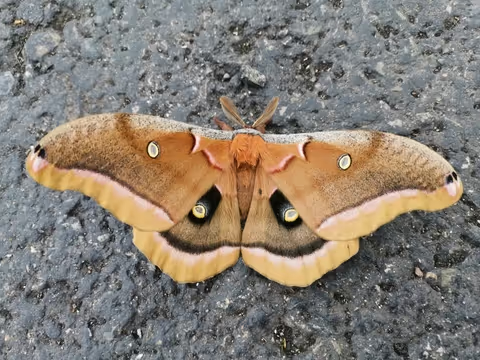
Polyphemus moths (Antheraea polyphemus) are one of the largest members of the silk moth (Saturniidae) family. They were named after the cyclops Polyphemus from Greek mythology.
Their wingspans range from 3-6 inches (10-15 cm). Their most prominent feature are the eyespots on their hindwings, which are transparent and ringed in yellow, blue, and black. They also have smaller eyespots on their forewings ringed with these same colors. When threatened, polyphemus moths flap their wings to expose the eyespots to startle their predators.
The rest of their wings are yellowish to reddish-brown in color with gray bands. The undersides of their wings are mottled brown. Coloration can vary wildly among moths, even among those within the same area. Their bodies tend to be the same shade of brown as their wings.
Males and females are easily distinguished by their antennae. Polyphemus moths have comb-like antennae with the males’ antennae being larger than the females’. Males use their larger antennae to detect pheromones release by the females. Females also possess a larger abdomen than males since they spend much of their adult life laying eggs.
Polyphemus moths can be found throughout continental North America from southern Canada to Mexico, with exception of Arizona and Nevada. They can be found in deciduous forests, orchards, and wetlands, though they can adapt to urban and suburban areas so long as there are adequate food sources.
The larvae are bright green with brown heads and legs. They grow up to 3-4 inches long and molt a total of five times. They feed on a variety of trees and shrubs, including maple, rose, willow, birch, beech, and oak. Once they finish eating a leaf, they sever the petiole (the stalk connecting the leaf to the stem) at the base. It is speculated that they do this to remove evidence of feeding, thus helping them hide from predators.
The moths overwinter in silk cocoons. The placement of the cocoon varies. Some attach themselves to shrub or tree branches, some attach themselves to leaves that then fall to the ground during the winter, and some attach themselves to leaves or grasses that are already on the ground. The cocoon does not have any holes, so when it is time for them to emerge, they secrete an enzyme to help break down the walls of the cocoon. They also have chitinous spurs near the base of their wings that they use to help tear themselves out of their cocoons.
Adult moths do not feed. They do not even have mouths. They typically emerge from their cocoons from May to July and only live for about a week, just long enough to reproduce. Females lay eggs on plants, either individually or in groups of 2-3. The eggs are light brown with two brown rings and oval shaped. Since polyphemus moths are nocturnal, they rest with their wings folded behind them during the day while mating and egg-laying occur at night.
References
Antheraea polyphemus (Cramer, 1776). Pacific Northwest Moths. (n.d.). Retrieved July 2, 2022, from http://pnwmoths.biol.wwu.edu/browse/family-saturniidae/subfamily-saturniinae/antheraea/antheraea-polyphemus/
Hall, D. (2012, July). Polyphemus moth. University of Florida. Retrieved July 2, 2022, from https://entnemdept.ufl.edu/creatures/MISC/MOTHS/polyphemus_moth.htm
Montana Natural Heritage Program. (n.d.). Polyphemus Moth - Antheraea polyphemus. Montana Field Guide. Retrieved July 2, 2022, from https://fieldguide.mt.gov/speciesDetail.aspx?elcode=IILEW0S010
Polyphemus moth Antheraea Polyphemus (Cramer, 1776). Butterflies and Moths of North America. (2006, June 28). Retrieved July 2, 2022, from https://www.butterfliesandmoths.org/species/Antheraea-polyphemus
© Laura Caldwell, July 2022
Touch whale bones, examine shipwreck artifacts and connect with the coast's living history.

Support our mission, get involved in educational programs, or contribute through donations and volunteering.