Marine Life
Pacific Blood Stars
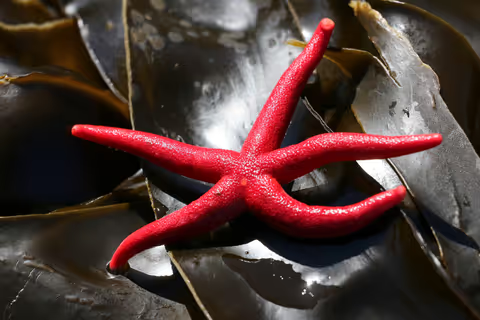
Pacific blood stars (Henricia leviuscula) are one of the more common sea stars in the Pacific Northwest. They can be found in the Eastern Pacific Ocean from the Aleutian Islands in Alaska to Baja California, Mexico. They typically live in more protected areas, such as rocky substrates, crevices, and pools, from the intertidal and subtidal zones up to 2,200 feet (671 m).
They are about 3-5 inches (8-12 cm) in diameter and typically have 5 rays around a small central disk, though they can have 4 or 6.The rays are slender, lacking any swelling around the base. Like other sea stars, they are capable of re-growing lost rays. They are cream to bright red in color. The aboral side (the side opposite the mouth) has many small ossicles with depressions in between. They lack pedicellariae, small appendages which help keep echinoderms free of debris or parasites.
Pacific blood stars are omnivorous, unlike most sea stars in the Pacific Northwest which are carnivorous. They feed on sea sponges and bryozoans by extruding their stomachs and placing them on the surface of their prey. They also feed on bacteria that has stuck to mucus on the surface of their bodies by passing the mucus to their mouths. Birds are the primary predators of blood stars.
Blood stars reproduce sexually with spawning occurring in April or May. Once the eggs have hatched, they go through larval and juvenile stages. Their rays begin to form during the latter stage.
Currently, there is some debate among the scientific community as to whether Henricia leviusculais a species or a species complex. For instance, there are some notable behavioral differences between Henricia leviuscula. Some females do not brood their young, instead releasing their eggs into the ocean. However, some do brood their young in brooding pouches near the mouth until the eggs hatch. It has been observed that larger blood stars tend to release their eggs while smaller ones tend to brood, but it has yet to be determined whether this is merely due to variation or they are actually distinct species. It is also possible the brooders are actually dwarf mottled stars (Henricia pumila), which were only separated from Henricia leviuscula in 2010 (Eernisse et al 2010).
Another reason they are suspected to be a species complex is due to their variability in appearance. Some sources state Pacific blood stars are not mottled (Cowles 2005) while others state they can have some gray or lavender mottling near the central disk (Brietzke and Starzomski 2013).
Like other species of sea star in Washington’s waters, Pacific blood stars are susceptible to sea star wasting disease. In a 2014-2015 study on sea star wasting disease in the Salish Sea, researchers found Henricia species to be less impacted by the disease than several other species in the study, such as sunflower sea stars (Pycnopodia helianthoides) and pink sea stars (Piaster brevispinus).
Despite being a common species to the Pacific Northwest, there is much still to learn about Pacific blood stars. If you’d like to see one for yourself, you are more likely to find one in a tidepool than on the beach. Remember to observe proper tidepool etiquette and see what you can learn.
Brietzke, C., &Starzomski, B. (2013). Blood star • henricia leviuscula. Biodiversity of the Central Coast. Retrieved December 10, 2021, from https://www.centralcoastbiodiversity.org/blood-star-bull-henricia-leviuscula.html.
Cowles, D. (2005). Henricia leviuscula (Stimpson, 1857) .Henricia Leviuscula. Retrieved December 10, 2021, from https://inverts.wallawalla.edu/Echinodermata/Class%20Asteroidea/Henricia_leviuscula.html.
Eernisse, D. J., Strathmann, M. F., & Strathmann, R. R. (2010). Henricia pumila sp. nov.: A brooding Seastar (Asteroidea) from the coastal Northeastern Pacific. Zootaxa, 2329(1), 22. https://doi.org/10.11646/zootaxa.2329.1.2
Lambert, P. (2000). Henricia Leviuscula (Stimpson, 1857). Henricia leviuscula, Pacific blood star. Retrieved December 11, 2021, from https://www.sealifebase.ca/summary/Henricia-leviuscula.html.
McDaniel, N. (n.d.). Blood Star. Sea stars of the Pacific Northwest . Retrieved December 9, 2021, from https://www.seastarsofthepacificnorthwest.info/blood-star.html.
Montecino-Latorre, D., Eisenlord, M. E., Turner, M., Yoshioka, R., Harvell, C. D., Pattengill-Semmens, C. V., Nichols, J. D., & Gaydos, J. K. (2016). Devastating transboundary impacts of sea star wasting disease on subtidal asteroids. PLOS ONE, 11(10). https://doi.org/10.1371/journal.pone.0163190
© Laura Caldwell, December 2021
Touch whale bones, examine shipwreck artifacts and connect with the coast's living history.

Support our mission, get involved in educational programs, or contribute through donations and volunteering.