Marine Life
Ochre Sea Stars
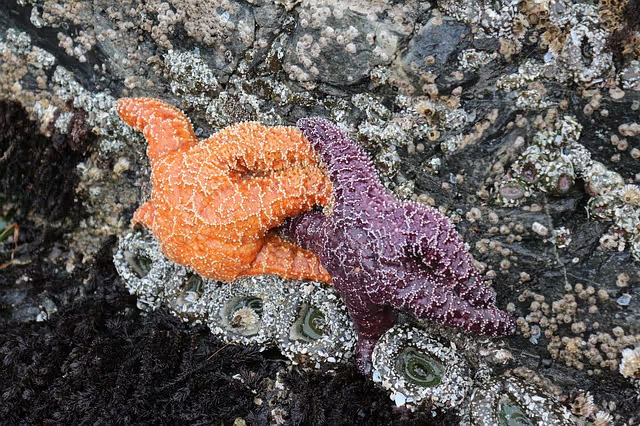
Pisaster ochraceus, more commonly known as ochre sea stars, ochre starfish, or purple starfish are a common sight in Pacific Coast tide pools. If you’ve been to Damon Point when the tide pools are visible, chances are you’ve seen one of these starfish.
As their common names suggest, the coloration of ochre sea stars vary from purple to orange to reddish brown. Purple is more common in Puget Sound while orange is more common in the Pacific Ocean, though both can occur in either area (Slater Museum, n.d.). It is not currently known what causes these differences in coloration.
They usually have five rays (arms), arranged around a central disk, but can have as few as four rays and as many as seven. Their rays are about 9cm in diameter and they are capable of regenerating a lost ray. Over the course of their life, ochre stars can grow between 15 and 36cm in diameter depending on their food supply.
Their range is from Prince William Sound in Alaska to Baja California, Mexico. They are usually found in the middle to low intertidal zones on wave-swept rocky shores, though they can also be found subtidally on rocks to 90m (MARINe, n.d.). They are a cold water species, making them abundant in the Pacific Northwest. Ochre sea stars are able to survive up to eight hours out of the water and can tolerate a thirty percent loss of body weight in body fluids.
The aboral side of an ochre sea star’s body is covered in while spines called ossicles. These are used to keep their bodies free of parasites. The mouth is on the oral side of the starfish along with their tube feet. They use tube feet to move, catch prey, and cling to rocks and other surfaces. Ochre sea stars do not have brains, instead having a nerve ring which communicates with the star’s radial nerves.
There is no sexual dimorphism in ochre sea stars, therefore the only way to determine the sex of the species is by examining the gonads. At the start of the breeding season (May-July), the gonads can grow very large—up to forty percent of the sea star’s body weight. Ochre sea stars reproduce through broadcast spawning and a female can produce 40 million eggs. The offspring go through several larval stages and float alongside plankton until they are large enough to settle on the rocks.
Ochre sea stars prey on a number of species including barnacles, mussels, snails, limpets, and chitons. They eat by enveloping their prey with their arms and using their tube feet to open the shells. They then evert their stomachs out through their mouths and into the shell, allowing them to digest the creature. Digestion takes two or three days.
These sea stars are considered a keystone species, meaning that their presence has a substantial impact on their environment. In the rocky intertidal zone, they are one of the main predators of California mussels (Mytilus californianus). Without the presence of ochre sea stars, California mussels can take over the rocks, not leaving enough space for other species to thrive. With the presence of ochre sea stars, mussel populations are kept in check, allowing for greater species diversity.
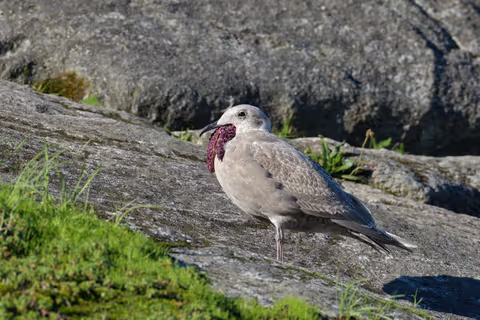
On top of being a keystone species, ochre sea stars have only two predators themselves: sea otters and seagulls. While sea otters will eat ochre sea stars of any size, gulls will only eat those under 6cm in radius (Slater Museum, n.d.). Additional threats include disease—particularly sea star wasting syndrome, which causes sea stars to lose their legs and deteriorate, leading to their death—and human activity.
Ochre sea stars are an awe-inspiring species and a delightful sight in any Pacific Northwest tide pool. Just remember—if you see one, don’t touch it or move it from where you found it. They are needed to help maintain the health and diversity of their habitat.
References
McFadden, M. (2002). Pisaster ochraceus. Retrieved February 22, 2021, from https://inverts.wallawalla.edu/Echinodermata/Class%20Asteroidea/Pisaster_ochraceus.html
University of California Santa Cruz MARINe (n.d.). Pisaster (Ochre Star). Retrieved February 22, 2021, from https://marine.ucsc.edu/target/target-species-pisaster.html
University of Puget Sound Slater Museum of Natural History (n.d.). Ochre Sea Star. Retrieved February 21, 2021, from https://www2.pugetsound.edu/academics/academic-resources/slater-museum/exhibits/marine-panel/ochre-sea-star/
© Laura Caldwell, March 2021
Touch whale bones, examine shipwreck artifacts and connect with the coast's living history.

Support our mission, get involved in educational programs, or contribute through donations and volunteering.