Birds
Merlin
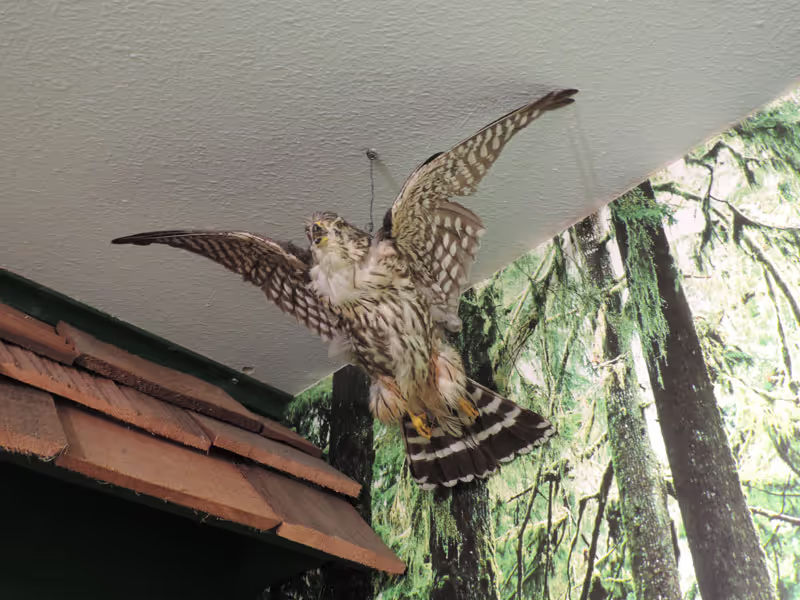
Have you ever seen a certain bird flying around the dunes throughout the year? One that flies much like a bald eagle or a peregrine falcon, but is too small to be either of them? Well, it may be that you’ve seen a merlin.
Merlin (Falco columbarius), once known as pigeon hawks, don’t get their name from the wizard Merlin in Arthurian legend. Instead, their name is derived from the French esmerillon, which means “falcon” (Kern Audubon Society 2021).
They can be found throughout North America and Eurasia. In North America, there are three subspecies: taiga merlin (F. c. columbarius), prairie merlin (F. c. richardsonii) and black merlin (F. c. suckleyi) Both taiga and black merlin can be found in Washington. Taiga merlin are more typically found east of the Cascades, though they can be found in Western Washington during migration (Urban Raptor Society n.d.). Black merlin are found year-round along the Pacific Coast and Puget Sound. The first documented merlin nest in Seattle was found in 2008 and the Urban Raptor Conservancy reports that the urban and suburban merlin populations in Washington are likely expanding (Urban Raptor Society n.d.).
Black merlin get their name from their coloration, which is overall darker than the other North American subspecies. Males have dark charcoal-gray backs, wings, and tails while in juveniles and females they are brownish-gray. Their chests are whitish or buff colored with brown streaking. They are 9.4-11.8 inches (24-30 cm) in length with a 20.9-26.8 inch (53-68 cm) wingspan. They are a little larger than American kestrels in size and like most raptors the female is larger than the male.
Merlin tend to prefer open habitat, such as shrubland, grassland, taiga forests, prairies, and dunes. They also tend to live near water, including estuaries, lakes, rivers, and coastlines.
Merlin primarily prey on small birds such as sandpipers or house sparrows, but may also prey on larger birds such as ducks, insects, and small mammals such as bats and rodents. They are primarily preyed upon by larger raptors or great horned owls. They can be very aggressive when defending themselves or their nests from predators.
Mating occurs in May or June. Merlin are monogamous and often stay together for several seasons. They do not build their nests. Instead they will use abandoned corvid or hawk nests, making few, if any modifications. However, they are selective of nest sites, preferring trees in a semi-open area, though they may also nest in tree cavities, cliffs, or on roofs.
The incubation period is 28-32 days. The female does the majority of the incubation while the male brings food and defends the nest. Clutch size is 4-5 egg. The hatched young remain in the nest for 25-30 days before fledging, after which they will stay close to the nest for another 30 days before leaving. They reach sexual maturity at one year of age.
References
Kern Audubon Society. (2021, February 28). Bird of the week: Merlin. Kern Audubon Society. https://www.kernaudubonsociety.org/bird-of-the-week-merlin/
Urban Raptor Conservancy. (n.d.). Seattle merlin project. Urban Raptor Conservancy. https://urbanraptor.org/research/seattle-merlin-project/
Hawk Mountain Sanctuary. (n.d.). Merlin . Hawk Mountain Sanctuary. https://www.hawkmountain.org/raptors/merlin
Cornell Lab of Ornithology. (n.d.). Merlin . All About Birds, Cornell Lab of Ornithology. https://www.allaboutbirds.org/guide/Merlin/overview
© Laura Caldwell, July 2023
Touch whale bones, examine shipwreck artifacts and connect with the coast's living history.

Support our mission, get involved in educational programs, or contribute through donations and volunteering.