Beachcombing
Is a Rock Only a Rock?
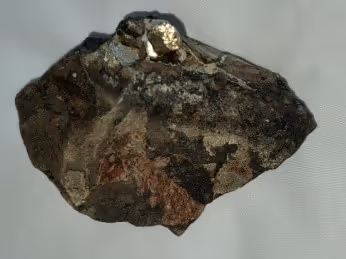
Unless we are geologists or are able to somehow cut a stone open and determine the makeup of a rock, we have to look at what we have learned about rocks to determine if what we pick up on the beach might be what we think it is.
It’s hard to determine where a rock came from which would help to tell us what it is. Most of our beach rocks originated from volcanic action, washed down from the mountains, through the rivers and streams, to the ocean then up onto the beach. And it’s also possible a rock on our beach came from the coast of Florida in someone’s pocket then dropped on our beach.
Here are some hints at what we might look for.
COMMON BEACH ROCKS
Basalt Rocks
Basalt is an extrusive igneous rock from volcanic lava flows. It is the most common type of rock on the earth’s crust and makes up most of the ocean floor. It forms when lava erupts to the surface and cools quickly (days or months; not decades), preventing minerals from crystalizing to a visible size. There are many types of basalt but the common basalt rocks found on Ocean Shores beaches have very fine to fine grains, are smooth and can be reddish, brown, grey to black, or dark greenish.
If gases or water is mixed within the lava, holes or vesicles can form and remain as the rock forms. Veins or pockets of crystals can grow and minerals can form when ground water and elements seep into the available spaces. (This is how the crystals and pyrite cube formed in that chunk of basalt.)

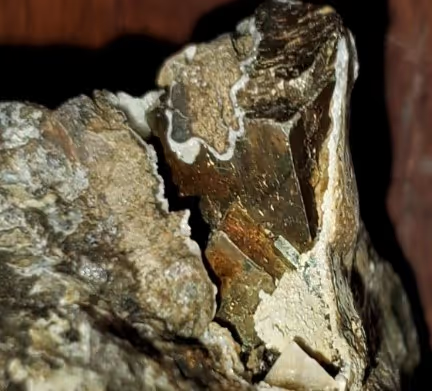
If you look closely at this kind of rock, you might find a surprise.
Among the crystals we see a shiny gold spot – Fools Gold?

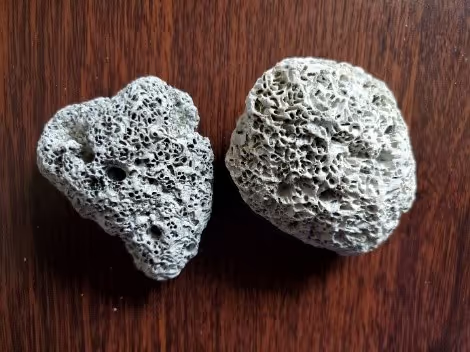
Dead Coral
As global temperatures rise and heats the world’s oceans, we see the once beautiful, colorful coral reefs turn into lifeless skeletons. The dead coral reefs are one tragedy in the oceans.
In 2016, heat stress encompassed 51 percent of coral reefs globally and was extremely severe. The first mass bleaching of the northern and far northern Great Barrier Reef killed 19 percent of the reef’s shallow water corals.
Coral gets its coloration from the same place it gets its nutrients: an alga called Symbiodinium, which literally lives inside the coral polyp’s body and feeds it nutrients produced through photosynthesis. It’s one of nature’s stranger symbiotic relationships.
The algae that provide the coral with energy are expelled as the temperature rises causing the coral to starve and die resulting in massive bleaching events to occur.
Petrified Wood results when a tree or tree-like plant has been replaced by stone. The materials making up the cell walls have been replicated with minerals. Unlike other plant fossils, which are typically impressions or compressions, petrified wood is a three-dimensional representation of the original organic material.


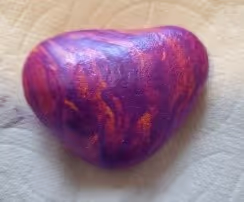
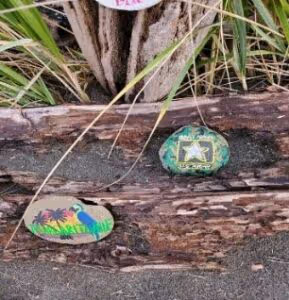
Painted Stones that we find now and then are a special treat, especially for children. Some are quite spectacular, often sending a message of welcome to the visitor. They are becoming more popular; some have been found far away from the beach.


© Jean Lingg, November 2021
Touch whale bones, examine shipwreck artifacts and connect with the coast's living history.

Support our mission, get involved in educational programs, or contribute through donations and volunteering.