Crabs
Hairy Shore Crab
If you’ve been following the news here in the Pacific Northwest, you’ve probably heard of the European green crab. Just this year, a European green crab was found in Hood Canal for the first time, another was found in Chuckanut Bay for the first time, and several were found in Alaska for the first time. In January 2022, Governor Jay Inslee issued an emergency order to address the issue following the Lummi Indian Business Council declaring a disaster in November 2021 in response to the capture and removal of 70,000 European green crabs from the Lummi Sea Pond.
As a Prohibited species, it is illegal to possess or transport live European green crabs in Washington without a permit. The Washington Department of Fish and Wildlife are also asking that the public not kill suspected green crabs. “This may sound counterintuitive,” they say, “but is intended to protect native crabs from cases of mistaken identity” (WDFW n.d.).
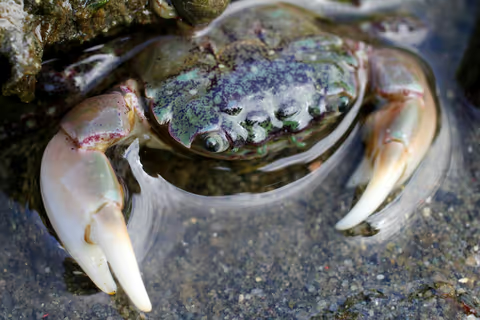
One of these native crabs is the hairy shore crab (Hemigrapsus oregonensis), also known as the green shore crab, the yellow shore crab, the Oregon shore crab, and the mud flat crab. As their multitude of common names suggest, they can be a variety of colors including green, yellow, gray, or white, with black, purple, or reddish spotting. The spotting can be present on their carapaces and legs, but not their claws. Their carapaces are rectangular and can grow up to 1.4 inches (34.7mm) for males and 1.1 inches (29.1mm) for females. Their eyes are wide-set, located near the front corners of their carapace (Oliver and Schmelter 1998).
The ‘hairy’ name comes from the setae on their legs, which given them a hairy appearance. These setae help them facilitate gas exchange, which allows them to live in muddy or even anoxic environments (underwater environments depleted of dissolved oxygen). Their setae also prevent sediment from entering their gills, which help them survive in muddy environments.
Their range is from Resurrection Bay, Alaska to Bahia de Todos Santos, Baja California and they are abundant throughout (Oliver and Schmelter 1998). They prefer the low to high intertidal zone of bays and estuaries, mud flats, green algae mats, and eelgrass beds. They can tolerate both hypersaline water and water with salinity as low as 4ppt (Oliver and Schmelter 1998).
Their diet consists primarily of diatoms and green algae, but they will eat meat if it is available. They are primarily preyed upon by seabirds and shorebirds, fish, and larger crabs, including European green crabs, who eat small crustaceans.
Females have larger abdominal flaps than males, which allow them to carry eggs. Females carry eggs—up to 11,000 of them—between February and May and hatching occurs between May and July. Some females carry a second brood that hatches in September. After hatching, the crabs go through five zoeal stages and one megalopa stage, which combined last about 4-5 weeks (Hiebert 2015). It can take an additional 3-9 weeks to reach adulthood depending on environmental conditions.
One of the ways the hairy shore crab can be distinguished from the European green crab is the number of marginal teeth on the carapace. The hairy shore crab has three while the European green crab has five. Hairy shore crabs also have rounded claws with no markings while the claws of a European green crab are not rounded and may sometimes have blue tips. Finally, they can be distinguished by the frontal lobes, called rostral bumps, on their carapace; the hairy shore crab has two while the European green crab has three (Washington Sea Grant Crab Team n.d.).
The Washington Sea Grant Crab Team has extensive ID guides here[read more about Identifying European Green Crab] to help you distinguish European green crabs from hairy shore crabs and many other native crab species. If you think you’ve found a European green crab, you can report it to WDFW here[go to WDFW] and the Washington Sea Grant Crab Team here[go to Report a European Green Crab Sighting]. But once you’ve taken your photos, it is best to leave the crab alone.
References
Brietzke, C., Fretwell, K., &Starzomski, B. (2016). Hairy shore crab • hemigrapsus oregonensis. Biodiversity of the Central Coast. Retrieved September 9, 2022, from https://www.centralcoastbiodiversity.org/hairy-shore-crab-bullnbsphemigrapsus-oregonensis.html
Cowles, D. (2005). Hemigrapsus oregonensis (Dana, 1851). Hemigrapsus oregonensis. Retrieved September 9, 2022, from https://inverts.wallawalla.edu/Arthropoda/Crustacea/Malacostraca/Eumalacostraca/Eucarida/Decapoda/Brachyura/Family_Grapsidae/Hemigrapsus_oregonensis.html
European Green Crab (Carcinus maenas). Washington Department of Fish & Wildlife. (n.d.). Retrieved September 9, 2022, from https://wdfw.wa.gov/species-habitats/invasive/carcinus-maenas
European Green Crab. Washington Department of Fish & Wildlife. (n.d.). Retrieved September 9, 2022, from https://wdfw.wa.gov/species-habitats/invasive/greatest-concern/egc
Hiebert, T. C. (2015) Hemigrapsus oregonensis. In: Oregon Estuarine Invertebrates: Rudy’s Illustrated Guide to Common Species, 3rd ed. T.C. Hiebert, B. A. Butler and A. L. Shanks (eds). University of Oregon Libraries and the Oregon Institute of Marine Biology. Retrieved September 11, 2022, from https://oimb.uoregon.edu/wp-content/uploads/2019/03/H_oregonensis_2018.pdf
Identifying European Green Crab. Washington Sea Grant Crab Team. (n.d.). Retrieved September 11, 2022, from https://wsg.washington.edu/crabteam/greencrab/id/
Oliver, J., & Schmelter, A. (1998). Life History of the native shore crabs Hemigrapsus oregonensis and Hemigrapsus nudus and their distribution, relative abundance and size frequency distribution at four sites in Yaquina Bay, Oregon. Corvallis, OR; Oregon State University.
Willason, S. W. (1981) Factors influencing the distribution and coexistence of Pachygrapsus crassipes and Hemigrapsus oregonensis (Decapoda: Grapsidae) in a California salt marsh. Marine Biology. 64:125–133. Retrieved September 9, 2022 from https://doi.org/10.1007/BF00397101
© Laura Caldwell, September 2022
Touch whale bones, examine shipwreck artifacts and connect with the coast's living history.

Support our mission, get involved in educational programs, or contribute through donations and volunteering.