Marine Life
Giant Sea Star
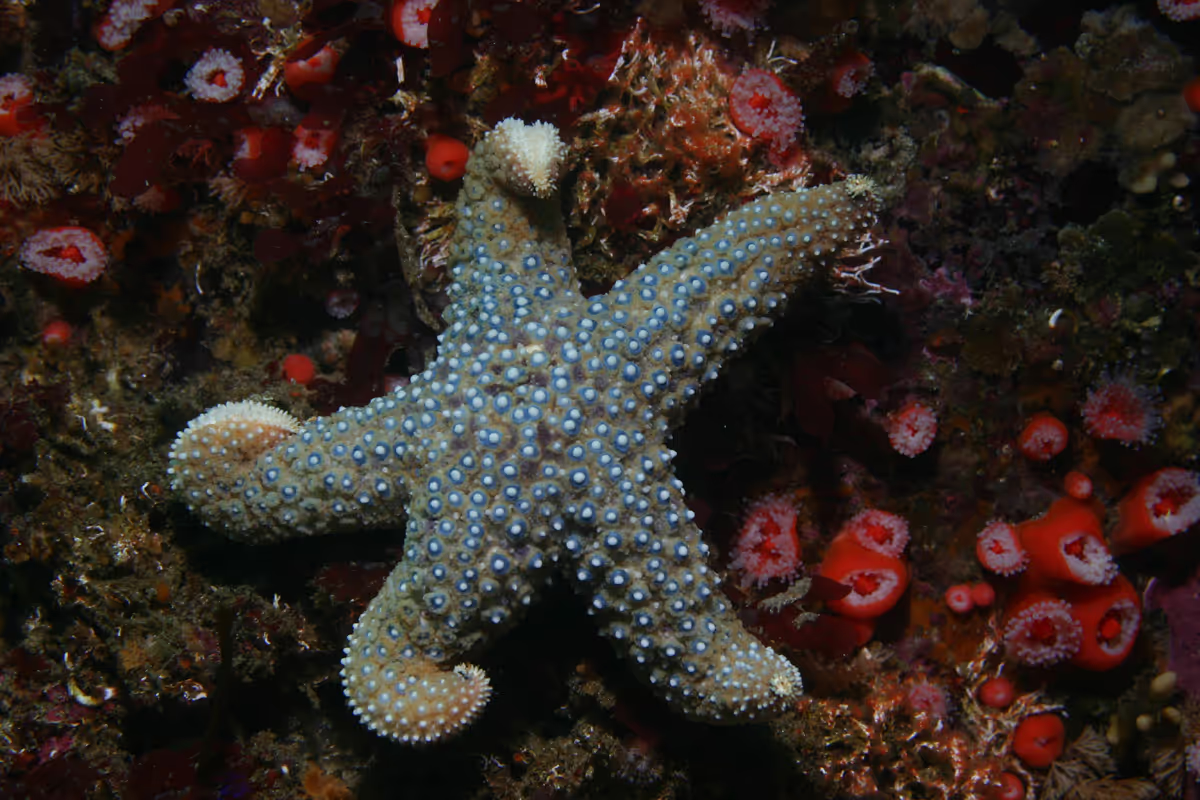
The giant sea star (Pisaster giganteus), also known as the giant-spined sea star, is a species of sea star native to the west coast of North America. It can be found from Vancouver Island, British Columbia to Isla Cedros, Baja California, though it is more abundant in the southern part of its range.
They can be found in the subtidal up to a depth of 300 feet (90 m). While they rarely breach the surface of the water, they can sometimes be found in the low intertidal as well. They prefer rocky bottoms, though they can sometimes be found on sandy bottoms.
They typically have five arms. Despite the name, they can only grow up to about 24 inches (60 cm) in diameter, and only the subtidal populations can reach this size. Giant sea stars living in the intertidal are on average smaller than the average ochre sea star (which only grow up to a maximum of 14 inches, or 36cm).
However, they do have larger spines than most sea stars. Their spines (also called ossicles) are blunt and blue with white, pink, or purple tips. The base of each spine is ringed in blue, with another ring of brown pedicellariae around that. Their bodies can be brown, tan, yellow, or purple.
Like many sea stars, giant sea stars are capable of regenerating lost arms. In fact, giant sea stars can fully regenerate their bodies even if they lose all but one of their arms. If cut in half, each half will regenerate their missing half, becoming two new sea stars.
Giant sea stars are active predators that feed on bivalves, limpets, chitons, barnacles, and gastropods. Like all sea stars, they eat by extruding their stomachs out of their mouths, enveloping their prey, and drawing their stomach back into their bodies once the prey has been digested. They have very few predators themselves, primarily sea otters and seabirds. Although interestingly gastropods have been known to feed on giant sea star larvae (SIMoNn.d.).
Giant sea stars reproduce sexually via spawning. Spawning occurs between March and April. The juveniles are bilaterally symmetrical and become radially symmetrical in adulthood.
Giant sea stars were one of the species affected by the most recent outbreak of sea star wasting syndrome (which began in 2013), though they were not as severely affected as species such as ochre sea stars or sunflower sea stars. However, in a survey of the Channel Islands in California following an outbreak in 1997, giant sea stars were found to have declined by 56% (Eckert, Engle, and Kushner 2000). The species has not been evaluated by the IUCN.
References
Classification of southern california sea stars. California State University Fullerton. (n.d.). Retrieved August 25, 2022, from http://biology.fullerton.edu/biol317/Murray/Fall97/sea_stars.html
Eckert, G., Engle, J., & Kushner, D. (1999). (rep.). Sea Star Disease and Population Declines at the Channel Islands. Retrieved August 25, 2022, from https://marine.ucsc.edu/data-products/sea-star-wasting/eckertetal_sswd_channel_islands_symposium_1999.pdf.
Foster, W. C., Armstrong, C. M., Chism, G. T., & Pruitt, J. N. (2017). Smaller and bolder prey snails have higher survival in staged encounters with the Sea Star pisaster giganteus. Current Zoology, 63(6), 633–638. https://doi.org/10.1093/cz/zow116
Giant-spined star. Sanctuary Integrated Monitoring Network. (n.d.). Retrieved August 25, 2022, from https://sanctuarysimon.org/dbtools/species-database/id/53/pisaster/giganteus/giant-spined-star/
Lonhart, S. (2006). Pisaster giganteus. Sanctuary Integrated Monitoring Network. photograph. Retrieved August 30, 2022, from https://sanctuarysimon.org/dbtools/photo-library/id/1878.
McDonald, G. (n.d.). Intertidal Invertebrates of the Monterey Bay Area, California. Seymour Marine Discovery Center. Retrieved August 25, 2022, from https://web.archive.org/web/20100806210236/http://www2.ucsc.edu/seymourcenter/Inverts/Echinodermata/Asteroidea/Pisaster_giganteus/Pisaster_giganteus.html
University of California Natural Reserve System. (n.d.). Giant Spined Star. Coal Oil Point Reserve. Retrieved August 24, 2022, from https://copr.nrs.ucsb.edu/natural-resources/invertebrates/giant-spined-star
Image credit: Steve Lonhart / NOAA MBNMS
© Laura Caldwell, August 2022
Touch whale bones, examine shipwreck artifacts and connect with the coast's living history.

Support our mission, get involved in educational programs, or contribute through donations and volunteering.