Wildlife
Everything You Need to Know About Cougars: Part 2
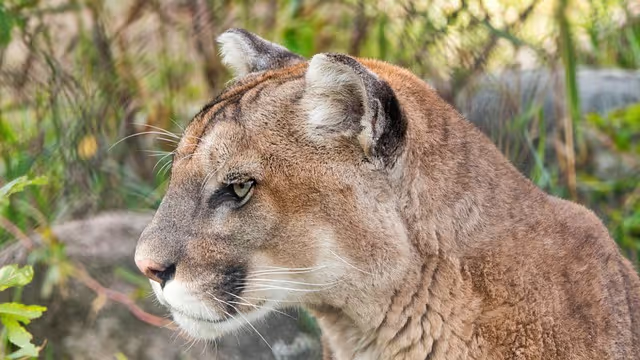
Welcome back to our series of blogs about Cougars! In this installment, we’ll be shining a spotlight on their tracks, droppings, daybeds, and scratching posts. We’ll also discuss the various calls they make. Let’s begin with their tracks!

Tracks
We mentioned previously that Cougars are solitary and secretive animals. While you might think that their tracks would be a hindrance to those objectives by making it clear that a Cougar was recently present at a particular location, that is not the case. Cougars generally leave “soft’ tracks (1). This means that they make only a minimal impact on the ground. Their tracks may be nearly invisible on packed earth or crusty snow (1). Additionally, Cougars keep their claws retracted most of the time (1). This means that, even if you do see Cougar tracks, you won’t likely see claw marks. Cougars keep their claws retracted so that they can preserve their sharpness, which is essential for gripping prey (1).
It may be slightly easier to spot Cougar tracks when there is snow on the ground compared to when the ground is snow-free. That is because Cougars carry their long, heavy tails in a wide “U” shape as they walk. The lowermost portion of their tail may leave drag marks between each print (1).
Droppings
Cougars normally cover their droppings with loose soil. Therefore, you aren’t overly likely to see them. When they are visible, they generally resemble those of most species in the cat family (1). However, cougars have well developed premolars that can slice through bone and hide. Therefore, their droppings often show chunks and fragments of chewed bone and considerable hair from the hide (1).
Cougar droppings sport a cylindrical shape. They are segmented and blunt at one or both ends (1). An average Cougar dropping measures 4-6 inches long by 1-1.5 inches in diameter. The size of the dropping may indicate the size of the Cougar (1). The bigger the dropping, the bigger the Cougar that left it.
Daybed Sites
Since Cougars are mostly active at night, they need someplace to go during the day. Unlike bears, Cougars don’t use dens. Instead, they use daybeds to rest, seek shelter for inclement weather, and to raise their young (1). Because Cougars cover large ranges of territory, they don’t tend to use the same daybed repeatedly. Instead, they select new daybeds as they go about their business.
They do not prepare their daybeds in any way (1), which is in contrast to the preparation that many other species undertake to build nests. Cougars prefer to use caves, shallow nooks in cliff faces or on rocky outcrops when in mountainous areas (1). In forested areas, areas under large roots, areas under fallen trees, and thickets are the go-to sites for daybeds. Daybeds are often located near kill sites (1). Therefore, if you come across a fresh or fairly recent kill site, there is likely a Cougar resting nearby in a daybed.
Scratching posts
Just like house cats, Cougars have to keep their claws sharp. This means that they have to scratch regularly. Cougars will mark the boundaries of their territories by leaving claw marks on stumps, trees, and, in some cases, fence posts (1). Adult Cougars will leave claw marks approximately 4-8 feet above the ground (1). If you see claw marks that less than 4 feet off the ground, they were probably left by a bobcat or a house cat. The marks that Cougars make consist of deep, long, parallel scratches running in an almost vertical fashion. These gashes don’t generally take off much tree bark (1). As a result, if you see a tree that has been clawed and it is missing a good chunk of bark, it probably wasn’t clawed by a Cougar. Instead, it was more likely clawed by a bear (1).
Calls
For being solitary and secretive animals, Cougars can occasionally be very noisy. Like most cats, they will mew, purr, and hiss. They will also growl, chirp, cry, and yowl from time-to-time. During mating season, Cougars will become loud, and make “eerie wailings and moans” during the night (1). These “wailings and moans” generally occur when competing males have intentions toward a single female (1). The wails have been compared to children crying, women screaming, and the screeching someone makes when they are immense pain (1).
Next Time
In our next post about Cougars, we will look at how rare Cougar attacks are and how you can prevent conflicts with Cougars on your property. See you then!
Reference
© Ian D. Caldwell, April 2023
Touch whale bones, examine shipwreck artifacts and connect with the coast's living history.

Support our mission, get involved in educational programs, or contribute through donations and volunteering.