Plants
Douglas Spirea
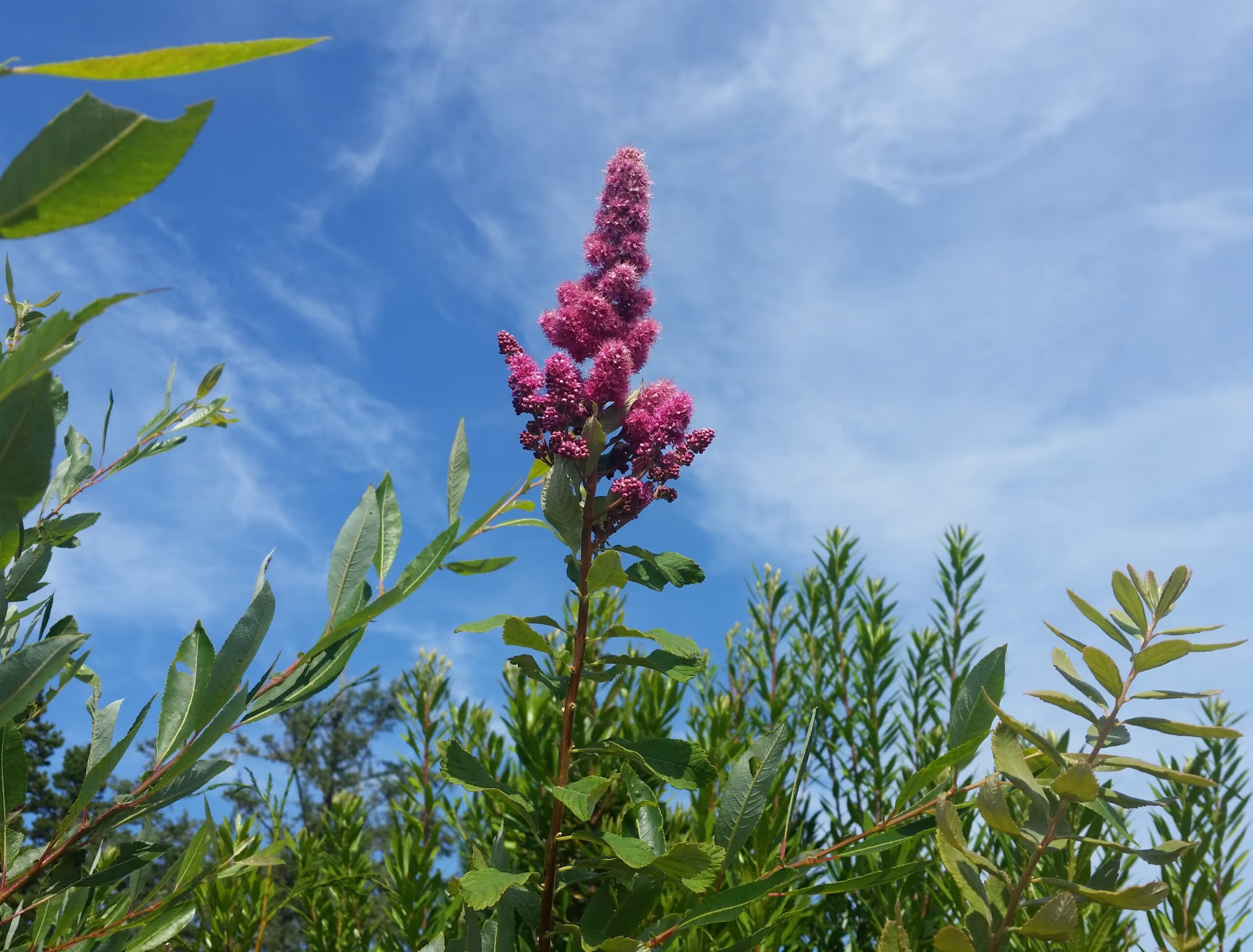
Happy Native Plant Appreciation Month! In honor of this year’s theme, Planting for Tomorrow, let’s take a look at native plant that can be used for wetland and riparian restorations: Douglas spirea.
Douglas spirea (Spiraea douglasii)--also referred to as rose spirea, Western spirea, hardhack, or steeplebush--is a deciduous shrub native to the Pacific Northwest. It is more commonly found west of the Cascades from southeastern Alaska to northern California, though it also occurs in Eastern Washington, Idaho, and western Montana. There are two subspecies: S. d. douglasii and S. p. menziesii.
Shrubs grow between 3-6 feet in height. Leaves are 1-4 inches (2.5-10.2 centimeters) long, oblong-shaped, and serrated toward the tips. They are dark green on top while the undersides are whitish and hairy. Flowers are pink in color and grow in conical clusters up to 8 inches (20 centimeters) in length. The flowers have long stamens which give the clusters a fuzzy appearance. Flowers bloom from June to September.
Douglas spirea attracts pollinators, including butterflies and hummingbirds. The plant also provides cover for birds and small mammals. It is known to be an important plant in marsh wren and grizzly bear habitat (Esser 2017). Though deer resistant, black-tailed deer will sometimes browse Douglas spirea. Beavers will eat it as well, though it is not a favorite of theirs (King County 2022).
Douglas spirea prefer areas with full sun to partial shade. It is typically found in riparian habitats, including stream and river banks, lakesides, bogs, and wet meadows. Despite preferring wetter habitats, Douglas spirea are fairly drought tolerant and can grow in areas that are only wet seasonally. It grows best on loamy soils.
The plant can reproduce by either seed or rhizome. Fruits are brown follicles that appear in September-October and can persist into the winter (Darris and Gonzalves 2009). If burned or cut to ground level, it is capable of resprouting.
Because it tends to form dense colonies, Douglas spirea has the potential to become invasive. In Europe, where it was introduced in the early 19th century, it is currently considered invasive in Belgium, Denmark, France, Germany, Ireland, and Latvia (EPPO 2008). In its native region, its aggressiveness can help it outcompete species that are invasive here, such as reed canarygrass or butterfly bush. However, even within their native region they are still capable of forming monocultures, particularly in disturbed areas. One Washington Department of Ecology guide to restoring wetlands recommends planning water depths to discourage their spread and planting woody vegetation such as Douglas spirea after the site water regime has been established (Stevens and Vanbianchi 1993).
If controlled to prevent monocultures, Douglas spirea can be an excellent native plant choice for habitat restorations. Within recent years, Douglas spirea has been used in the restorations of several watershed sites, including but not limited to the Qwuloolt Estuary (Tulalip Tribes n.d.), Anderson Creek near Bellingham (The Watershed Company 2021), and several sites in the North Olympic Peninsula (North Olympic Salmon Coalition n.d.)
References
Darris, D., & Gonzalves, P. (2009). Rose Spirea Plant Fact Sheet. Corvallis, OR; USDA NRCS. Retrieved April 17, 2023, from https://plants.usda.gov/DocumentLibrary/factsheet/pdf/fs_spdo.pdf
EPPO Reporting Service. (2008). Spiraea species: more information needed on their impact to the environment. Eppo Global Database. Retrieved April 17, 2023, from https://gd.eppo.int/reporting/article-664
Esser, L. (2017). Spiraea douglasii. Fire Effects Information System. Retrieved April 17, 2023, from https://www.fs.usda.gov/database/feis/plants/shrub/spidou/all.html
King County. (2022). (publication). Planning for Beavers Manual: Anticipating Beavers when Designing Restoration Projects . Retrieved April 17, 2023, from https://your.kingcounty.gov/dnrp/library/2022/kcr3436/kcr3436.pdf.
North Olympic Salmon Coalition. (n.d.). Planting trees for salmon and healthy communities! North Olympic Salmon Coalition. Retrieved April 17, 2023, from https://nosc.org/planting-trees-for-salmon-and-healthy-communities/
Stevens, M., & Vanbianchi, R. (1993). (publication). Restoring Wetlands in Washington: A Guidebook for Wetland Restoration Planning and Implementation (pp. 1–77). Olympia, WA: Washington Department of Ecology. Retrieved April 17, 2023, from https://apps.ecology.wa.gov/publications/documents/93017.pdf.
Tulalip Tribes. (n.d.). Qwuloolt Estuary Vegetation. Tulalip Qwuloolt Estuary Restoration Project . Retrieved April 17, 2023, from https://www.qwuloolt.org/QwulooltEstuary/EstuaryVegetation
The Watershed Company. (2021). (publication). Impact Evaluation Report Washington Conservation Corps Restoration Methods. Retrieved April 17, 2023, from https://salishsearestoration.org/w/images/4/41/Watershed_Company_2021_WCC_restoration_methods_evaluation.pdf .
© Laura Caldwell, April 2023
Touch whale bones, examine shipwreck artifacts and connect with the coast's living history.

Support our mission, get involved in educational programs, or contribute through donations and volunteering.