Plants
Common Snowberry
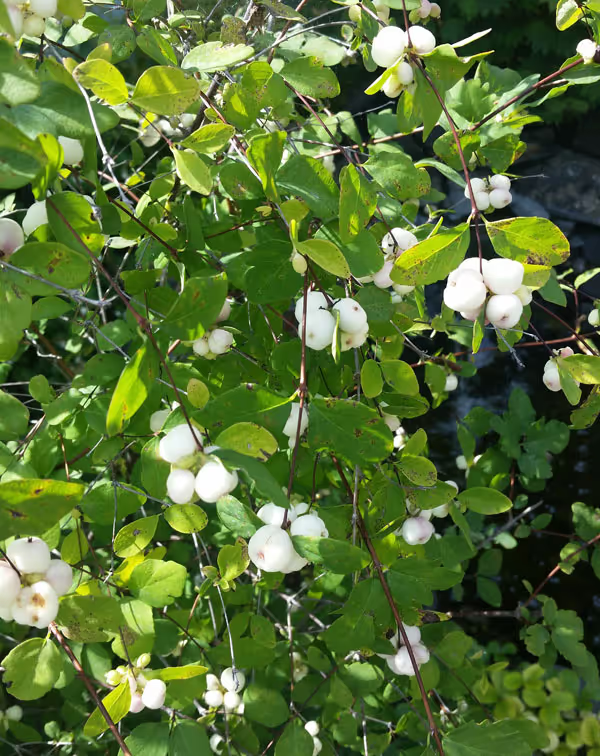
Snowberries (Symphoricarpos species) are a genus of deciduous shrubs in the honeysuckle family. There are fifteen species of Symphoricarpos in the world and fourteen are native to North and Central America (the outlier being Symphoricarpos sinensis, which is native to China). Common snowberry (Symphoricarpos albus) is native to North America and has two varieties: Symphoricarpos albus var. albus, which is native to Eastern North America, and Symphoricarpos albus var. laevigatus, which is native to the Pacific Coast. The latter is sometimes referred to as Symphoricarpos rivularis.
On the Pacific Coast, common snowberry can be found from southern Alaska to California, as well as Montana and Colorado. In Washington State, they can be found in a variety of environments from mid to low elevations on either side of the Cascades. Symphoricarpos albus var. laevigatus is one of the plants Lewis and Clark collected during their expedition. It was sent to England in 1817 and has since become naturalized across the British Isles.
They usually prefer open forests with full or partial sun and moist, well-draining soils. However, they are quite adaptable and can tolerate a variety of soil conditions. They do well in disturbed areas and due to their extensive root systems are a good choice for bank stabilization and erosion control efforts. They also take well to container gardens.
Common snowberries grow to an average of 3-4.5 feet, but can grow up to 6 feet in height. They tend to form thickets about 4-6 feet in size. It is sparsely branched. The leaves are oval shaped and can grow over 2 inches long. From May to August, snowberries produce pink or white bell-shaped flowers in clusters on the ends of their branches. These flowers are very attractive to bees, butterflies, and hummingbirds.

As one might expect from their name, snowberries produce white fruits. However, they don’t actually produce berries. Rather, they produce drupes, a fruit with a hard woody layer surrounding the seed. These woody encasements are called nutlets and each drupe contains two with one seed per nutlet. Though they can reproduce by seed, they more typically reproduce by rhizome. The fruits begin appearing in late summer and can last into the winter, making them a viable winter food source for birds such as grouse, robins, and thrushes.
In addition to birds and insects, they are also important browse for animals such as deer, bighorn sheep, domestic sheep, cattle, and grizzly bears. They provide cover for many bird species and small mammals, including pocket gophers and squirrels.
Snowberries contain saponins, which give the fruits a bitter taste and render then poisonous to fish. Though snowberry plants are poisonous to humans when consumed in excess, they can be consumed in small amounts and can be applied topically with little issue. Symptoms include vomiting and diarrhea.
In fact, numerous Native American tribes used them for medicinal or disinfectant purposes. According to Erna Gunter (1973), the Chehalis used the berries to clean hair, a poultice or infusion of the leaves as a wash for injuries, and a decoction of the root bark to treat venereal disease. The Klallam used a decoction of the leaves as a cold remedy and the Skagit used the berries as an antidote to poisoning and the bark as a tuberculosis remedy.
References
Gunther, E. (1973). Ethnobotany of Western Washington. University of Washington Press.
Kelley Bressette, D. (2017, February 27). Common snowberry, Symphoricarpos albus. Native Plants PNW. Retrieved November 11, 2021, from http://nativeplantspnw.com/common-snowberry-symphoricarpos-albus/.
Lady Bird Johnson Wildflower Center. (2010). Symphoricarpos albus. Lady Bird Johnson Wildflower Center - The University of Texas at Austin. Retrieved November 11, 2021, from https://www.wildflower.org/plants/result.php?id_plant=syal.
McWilliams, J. (2000). Symphoricarpos albus. Fire Effects Information System. Retrieved November 11, 2021, from https://www.fs.usda.gov/database/feis/plants/shrub/symalb/all.html.
Spurgeon, C. (2020). An appreciation of Snowberry (Symphoricarpos albus). Washington Native Plant Society. Retrieved November 11, 2021, from https://www.wnps.org/blog/an-appreciation-of-snowberry.
© Laura Caldwell, November 2021
Touch whale bones, examine shipwreck artifacts and connect with the coast's living history.

Support our mission, get involved in educational programs, or contribute through donations and volunteering.