Marine Life
Butter Clams
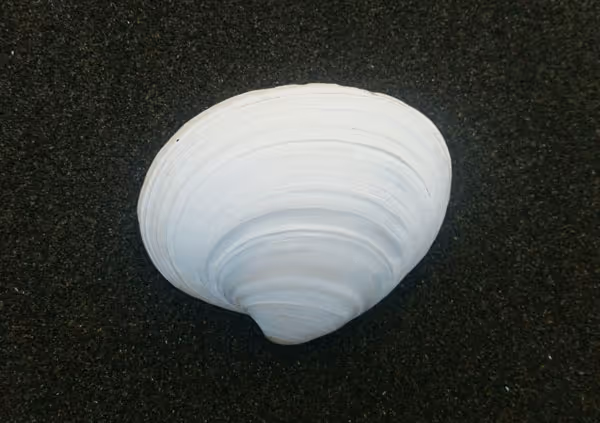
Take a walk around Damon Point and you’ll probably find a butter clam shell. They are one of the most abundant clam species in Washington State.
Butter clams (Saxidomus gigantea), also commonly called Washington butter clams or money shells, are saltwater bivalve mollusks found along the Pacific coast of North America from the Aleutian Islands of Alaska to San Francisco Bay. They are found in the intertidal zone up to 130 feet (40m) and are more commonly found in bays or estuaries than open coastlines as these areas offer more protection. They can be found in soft sediment anywhere from just beneath the surface to up to 12 inches (30cm) deep.
Like all bivalves, butter clams have two valves (articulating parts of the shell. In the case of bivalve mollusks, the entire shell is a valve) that can be opened and closed using their ligaments and adductor muscles, respectively. The shells are white both inside and out, though there can be some black or brown discoloration. They are oval shaped and the outside of the shell has only concentric ridges which run parallel to the edges of the shell. The inside has a pallial line, a pallial sinus, and two prominent adductor muscle scars. The hinge is external and thick with three cardinal hinge teeth.
The bodies of the clam are often reddish in color. They have a heart, a mouth, a stomach, a nervous system, a foot, a mantle, gills, and two siphons. The siphons are about 1.6 inches (4cm) long and they can be retracted into the shell. They are used for breathing, feeding, excretion, and reproduction.
They average 3-4 inches (10cm) in size but can grow up to 6 inches (15cm) in size. In order to be harvested in Washington State, they must be at least 1.5 inches (3.8cm) in size. It can take many years for butter clams to reach this size. They are usually large enough to reproduce at 3 years and can live for over 20 years.
Spawning occurs during the late spring. Butter clams have separate sexes and fertilization occurs outside the body. They develop into larvae merely 24 hours after fertilization and are free swimming for up to 30 days, after which they settle into the sediment.
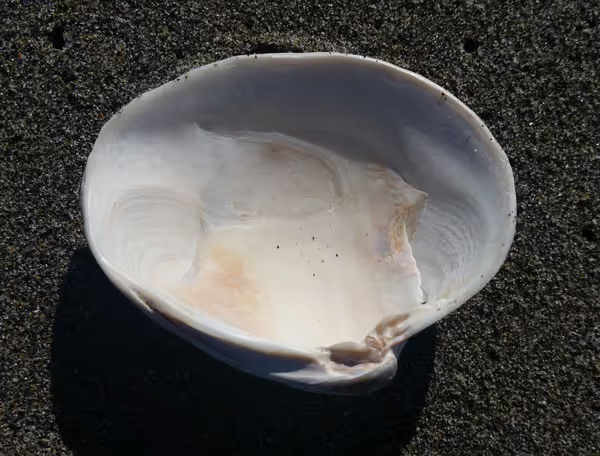
Butter clams are filter feeders, drawing in water with their siphons, straining out the phytoplankton, and expelling the rest of the water. They themselves are preyed upon by Dungeness crabs, sting rays, moon snails, sea stars, seabirds, and sea otters. They can form a symbiotic relationship with pea crabs, who reside in the mantle cavity of the clam.
Butter clams are edible and especially prized for chowders. As they are so abundant, many Indigenous cultures consumed butter clams and evidence from shell middens suggest for some cultures they were the most widely consumed clam species. In addition, dried butter clams can keep for months, making them a valuable trade item. According to Kuhnlein and Humphries, “both Chinookans and the Southwestern Coast Salish collected and dried clams in large quantities to trade to cultures in the east” and “Coast Salish women acquired special baskets and bags from the interior by trading dried clams” (2017).
Be sure to cut off the dark tips of the siphons before eating them, though. They are prone to consuming algae containing saxitoxins, so much so that the word “saxitoxin” is derived from the genus this species belongs to Saxidomus. These toxins can accumulate in the tips of the siphon and exist in the clam’s tissues for months. Consuming too many of these toxins can cause paralytic shellfish poisoning (PSP). Clams do this in part to reduce predation, as sea otters and seabirds are known to avoid clams with high levels of saxitoxins.
References
Cowles, D. (2005). Saxidomus gigantea Deshayes, 1839. Retrieved August 22, 2021, from https://inverts.wallawalla.edu/Mollusca/Bivalvia/Veneroida/Veneridae/Saxidomus_gigantea.html
Fisheries and Oceans Canada. (2018, February 07). Butter Clam. Retrieved August 24, 2021, from https://www.dfo-mpo.gc.ca/species-especes/profiles-profils/butterclam-palourdejaune-eng.html
Fretwell, K., & Starzomski, B. (2014). Butter clam • Saxidomus gigantea. Retrieved August 23, 2021, from https://www.centralcoastbiodiversity.org/butter-clam-bull-saxidomus-gigantea.html
Hiebert, T. C. (2015). Saxidomus giganteus. Retrieved August 23, 2021, from https://scholarsbank.uoregon.edu/xmlui/bitstream/handle/1794/12919/S_giganteus_2016_final.pdf?sequence=3&isAllowed=y
Kuhnlein, H., & Humphries, M. (2017). Traditional animal foods of indigenous peoples of Northern North America. Retrieved August 23, 2021, from http://traditionalanimalfoods.org/marine-invertebrates/bivalves/page.aspx?id=6504#wbc-e
Washington Department of Fish and Wildlife. (2021). Shellfish/Seaweed species rules. Retrieved August 23, 2021, from https://www.eregulations.com/washington/fishing/shellfish-seaweed-species-rules
© Laura Caldwell, August 2021
Touch whale bones, examine shipwreck artifacts and connect with the coast's living history.

Support our mission, get involved in educational programs, or contribute through donations and volunteering.