Plants
Bigleaf Maple
Here along the Washington Coast, we are known for our coniferous forests dominated by trees such as western hemlock, Douglas fir, Sitka spruce, and western red cedar. However, we are also home to some incredible deciduous trees. One such tree is the bigleaf maple.

Copyright Peter Pearsall/USFWS[
Bigleaf maples (Acer macrophyllum, also called Oregon maples) are the largest species of maple in North America, capable of growing up to 100 feet (30 m) in height. They range from southeast Alaska to southern California and from sea level to 1500 feet in elevation. They are typically found west of the Cascade and Sierra Nevada mountain ranges. They prefer moist sites, such as riparian areas and flood plains, with good drainage. They can tolerate drier areas, but they will have poorer growth.
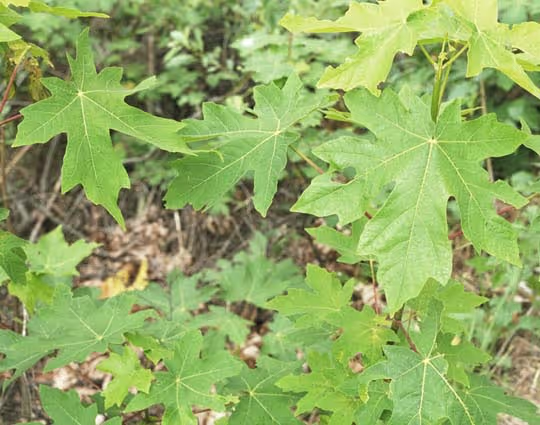
True to its name, bigleaf maple leaves can grow up to a foot (30 cm) wide and almost as long. They have five lobes and are palmate (palm-shaped). The top of the leaves are dark green in color while the undersides are a paler green. In the fall, they turn yellow in color. The stems are 6-12 inches (10-15 cm) in length and contain a milky sap that will leak out if the stem is severed.
Between April and May, bigleaf maples produce greenish-yellow flowers. These flowers grow in conical clusters called racemes and contain both male and female flowers, which are pollinated by insects. The flowers are edible to humans (BC n.d.).
Bigleaf maples begin to produce seeds when they are about 10 years of age. The seeds are large (2 inches, or 5 cm, in length) and turn from pale green to brown in color as they ripen. They are double-winged, forming an upside-down V shape. The seeds ripen in early autumn and are disbursed by the wind in late autumn (OWIC n.d.). Bigleaf maples can live to be 200 years old.
Copyright Bureau of Land Management
Bark on bigleaf maples is grayish-brown and smooth on young trees. Grooves develop in the bark as it ages. Because the bark is thin, it is not considered to be fire resistant (Fryer 2011). Because the bark is moist and high in calcium, bigleaf maples are able to host more mosses, lichens, and ferns than any other tree species in the Pacific Northwest (Fryer 2011).
Bigleaf maples support many species of fauna as well. The leaves are browsed on by deer, elk, mountain beavers, and invertebrates. Squirrels, finches, evening grosbeaks, and deer mice consume the seeds.
Humans have many uses for bigleaf maple. Indigenous peoples used the shoots and inner bark for food (BC n.d.; Favorite n.d.). An infusion of the bark was used to treat tuberculosis (Favorite n.d.). They also used the bark to create canoe paddles, utensils, ropes, and baskets (Fryer 2011). It is also used in musical instruments, furniture, and veneer (OWIC n.d). Sap from bigleaf maples can be used to make maple syrup, though due to its lower sugar content it does not produce as high a yield as other species of maple.
References
British Columbia Ministry of Forests. (n.d.). Bigleaf maple. Bigleaf Maple. https://www.for.gov.bc.ca/hfd/library/documents/treebook/bigleafmaple.htm
Daw, S. (2021, April). Bigleaf Maple (U.S. National Park Service). National Parks Service. https://www.nps.gov/articles/000/bigleaf-maple.htm
Favorite, J. (n.d.). Bigleaf Maple. Baton Rouge, LA; United State Department of Agriculture Natural Resources Conservation Service. https://plants.usda.gov/DocumentLibrary/plantguide/pdf/pg_acma3.pdf
Fryer, J. L. (2011). Acer macrophyllum. Fire Effects Information System (FEIS). https://www.fs.usda.gov/database/feis/plants/tree/acemac/all.html
Oregon Wood Innovation Center. (n.d.). Bigleaf maple (Acer macrophyllum). Oregon State University Oregon Wood Innovation Center. https://owic.oregonstate.edu/bigleaf-maple-acer-macrophyllum
© Laura Caldwell, December 2023
Touch whale bones, examine shipwreck artifacts and connect with the coast's living history.

Support our mission, get involved in educational programs, or contribute through donations and volunteering.