Marine Life
Bat Stars
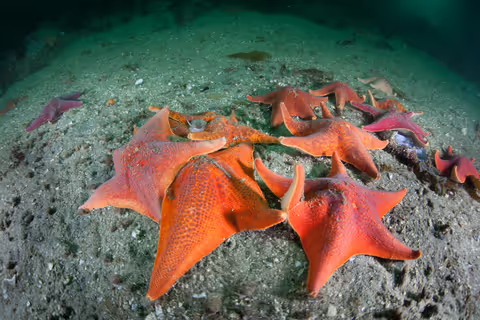
Bat stars (Patiria miniata), also called sea bats or webbed stars, get their common names from the webbing between their rays, which resemble the membrane that allows real bats to fly.
Bat stars can be found on the Pacific Coast from Alaska to Baja California. They are more abundant in the center of their range, namely Central California and Monterey Bay, but small populations can be found on the Washington Coast near Cape Flattery. They can be found in the intertidal zone up to 980 feet (300 meters) and are adaptable to a variety of environmental conditions, such as different water temperatures and salinities.
Unlike bats, the “webbing” between the rays of a bat star are not a membrane, but a depression in their bodily tissue. However, like real bats, bat stars can have a diverse array of colors. Red and orange are the most common, but bat stars can be yellow, green, blue, purple, and brown. They can also be either solid colored or mottled.
These stars typically have five rays, though they can have as few as four and as many as nine. Their central disk is wider than their rays are long. They have rough texture on their aboral surface (the side opposite their mouth) due to having numerous crescent-shaped ossicles.
Bat stars are opportunistic scavengers. They eat by extruding their one of their stomachs from their body, liquefying their prey by covering them with digestive enzymes, then consuming their prey. Then they pull their stomachs back into their bodies, where their second stomach digests their prey further. They typically eat other sea stars, surfgrass, tunicate worms, algae, decaying tissue, and aquatic invertebrates, though if nothing is available to scavenge they will extrude their stomachs into the water to catch microorganisms. They do not have the ability to open bivalves.
They have what’s called a commensal symbiotic relationship with polychaete worms (Ophiodromus pugettensis) who take up residence in the grooves on the bat star’s oral side. They don’t harm the bat star, but they don’t provide a benefit to them either. The worms, on the other hand, get a steady food supply in the bat star’s leftovers.
Bat stars are preyed upon by other sea stars, mollusks, and crustaceans. They defend themselves against prey by covering themselves in a foul-tasting mucus.
Bat stars reproduce by spawning. This usually occurs in the summer, but can occur throughout the year. They release eggs and sperm through pores in their arms with the females capable of releasing millions of eggs at a time. The larvae are free swimming, going through several stages within the course of about a month before reaching their adult stage. They live up to 35 years.
They are typically solitary. If two bat stars meet each other, they will push each other and try to get their ray on top of the other star to defend their territory or food.
References
Bat Star. Monterey Bay Aquarium. (n.d.). Retrieved March 3, 2022, from https://www.montereybayaquarium.org/animals/animals-a-to-z/bat-star
Cowles, D. (2005). Patiria miniata. Invertebrates of the Salish Sea. Retrieved March 3, 2022, from https://inverts.wallawalla.edu/Echinodermata/Class%20Asteroidea/Asterina_miniata.html
Fretwell, K. (2016). Bat Star. Biodiversity of the Central Coast. Retrieved March 7, 2022, from https://www.centralcoastbiodiversity.org/bat-star-bull-asterina-miniata.html
Friar, G. (2021, November 4). Unusual lab mates: Biology all-stars. Whitehead Institute of MIT. Retrieved March 3, 2022, from https://wi.mit.edu/unusual-labmates-biology-all-stars
Sea wonder: Bat Star. National Marine Sanctuary Foundation. (2021, January 8). Retrieved March 4, 2022, from https://marinesanctuary.org/blog/sea-wonder-bat-star/
© Laura Caldwell, March 2022
Touch whale bones, examine shipwreck artifacts and connect with the coast's living history.

Support our mission, get involved in educational programs, or contribute through donations and volunteering.