Birds
Barrow's Goldeneye
Barrow’s goldeneye (Bucephala islandica) is one of three members of the genus Bucephala, along with common goldeneyes (B. clangula) and buffleheads (B. albeola). Their genus name is derived from the Ancient Greek bucephalus, meaning “bullheaded,” while their species name refers to the population of ducks found in Iceland. Their common name was given after Sir John Barrow (1764-1848), Second Secretary to the Admiralty in Great Britain and arctic explorer. In Iceland, they are known as húsönd, meaning “horse duck.”
Barrow’s goldeneyes are found mostly in western North America from Colorado west of the Rocky Mountains to Alaska with small populations in Eastern Canada, Maine (where they are a threatened species), and Iceland. Some vagrants have been reported in Scotland (SOC 2005).
In Washington, they winter along the coast and in Puget Sound, preferring rocky and estuarine habitats rather than the open ocean. eBird data shows Barrow’s goldeneyes are only in Grays Harbor for the winter between September and March. During the breeding season, they move inland to lakes, ponds, and riparian areas in Central and Northeast Washington. They tend to return to the same breeding and wintering areas year after year.
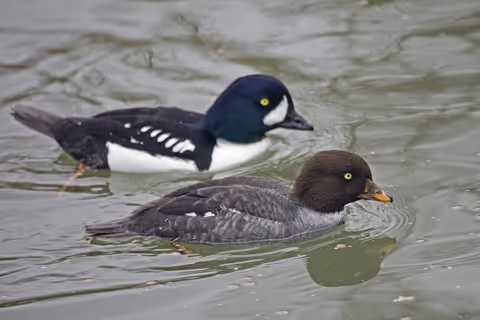
Males are about 19 inches (48 cm) in length and 2.8 pounds (1278 g). In breeding plumage, they have a black head with a purplish iridescence and a white crescent-shaped patch between their black bills and their eyes. Their sides, bellies, secondary feathers, and breasts are white while their backs, wings, and tails are black. They also have seven white spots on their wings. In non-breeding plumage, they resemble females.
Females are about 17 inches (43 cm) in length and 1.8 pounds (818 g). They have brown heads with a gray, brown, and white mottled body. Their bills are yellow.
Both males and females have amber irises and a wingspan of 27.6-28.7 inches (70-73 cm). They can be distinguished from common goldeneyes by their steeper foreheads and the aforementioned crescent-shaped white patch on the males.
Barrow’s goldeneyes are diving ducks. They primarily feed on animal matter, including aquatic insects, crustaceans, fish eggs, and mollusks. Which of these food sources they favor depends on their location: during the breeding season they favor insects while in the winter they favor mollusks. They also eat aquatic vegetation such as pondweeds, but these make up less than a fifth of their diet (Cornell Lab of Ornithology n.d.).
Barrow’s goldeneyes form breeding pairs at their wintering area and are monogamous. Females nest in tree cavities 6 to 48 feet above the ground, such as those formed by pileated woodpeckers. They will also nest in human-made nest boxes. Both males and females are territorial of their nesting site.
Clutches contain 6-12 eggs that are incubated for 29-31 days. Juveniles are capable of diving immediately after hatching (Sea Duck Joint Venture 2003). They fledge at 8 to 9 weeks of age. Males are able to breed at 2 years of age and females are able to breed at 3 years of age. The oldest recorded Barrow’s goldeneye was 18 years of age.
References
Cornell Lab of Ornithology. (n.d.). Barrow's Goldeneye Overview. Cornell Lab of Ornithology. Retrieved October 28, 2022, from https://www.allaboutbirds.org/guide/Barrows_Goldeneye/overview
eBird. (n.d.). Barrow's Goldeneye .eBird. Retrieved October 28, 2022, from https://ebird.org/species/bargol
Kulinski, M. (2014). Barrow’s goldeneye. BioKIDS. Retrieved October 28, 2022, from http://www.biokids.umich.edu/critters/Bucephala_islandica/
Maine Dept of Inland Fisheries and Wildlife. (n.d.). Can you tell the difference between a common and a Barrow's goldeneye? Maine Dept of Inland Fisheries and Wildlife. Retrieved October 28, 2022, from https://www.maine.gov/ifw/hunting-trapping/hunting/laws-rules/difference-common-barrows-goldeneyes.html
Scottish Ornithologists' Club. (2005). Online scottish bird report. Scottish Ornithologists' Club. Retrieved October 28, 2022, from https://www.the-soc.org.uk/about-us/online-scottish-bird-report
Sea Duck Joint Venture. (2003). Sea Duck Information Series: Barrow's Goldeneye (Bucephala islandica). Anchorage, AK; Sea Duck Joint Venture.
Washington Department of Fish & Wildlife. (n.d.). Barrow's goldeneye. Washington Department of Fish & Wildlife. Retrieved October 28, 2022, from https://wdfw.wa.gov/species-habitats/species/bucephala-islandica
© Laura Caldwell, October 2022
Touch whale bones, examine shipwreck artifacts and connect with the coast's living history.

Support our mission, get involved in educational programs, or contribute through donations and volunteering.