Birds
Barn Swallows
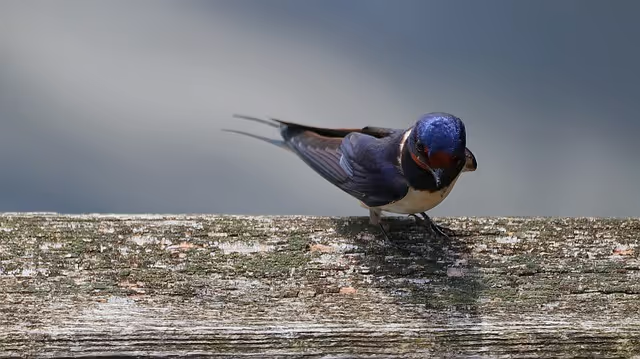
Living in Ocean Shores means encountering a number of the mysteries of the natural world. Such as what are all the plants that grow in the dunes? How is erosion affecting Damon Point? And what are those two birds that keep hanging around my porch railing and swooping around me every time I leave the house? All excellent questions, but today we will focus on the latter.
The short answer: they are barn swallows.
Barn swallows (Hirundo rustica) are one of the most widespread species of swallow in the world. There are six recognized subspecies. H. r. erythrogaster, or the American barn swallow, is found throughout the lower 48 United States, southern Canada, and southeastern Alaska during the breeding season. They winter in Central and South America.
Barn swallows are passerine, or perching birds. H. r. erythrogaster have dark cobalt upperparts, whitish to rust-colored underparts and facial markings. Their tails are long and forked with white spots that are visible when they are in flight. Males have more bold coloration than females. They are about 5.9-7.5 inches (15-19 cm) in length with a wingspan of about 11.4-12.6 inches (29-32 cm).
They can be found in open habitats, such as farms, fields, meadows, marshes, and grasslands. They are semi-colonial and will form groups consisting of one pair to a few dozen pairs.
Barn swallows almost exclusively eat insects. As they eat while flying, their preferred prey are flying insects such as flies, beetles, flying ants, wasps, bees, butterflies, and moths. They also drink while in flight by swooping down and drinking as they skim the water’s surface.
Historically, barn swallows nested in caves or under cliff overhangs. These days, barn swallows build their nests almost entirely on human structures, such as under eaves, bridges, or docks. Their nests are cup-shaped and made of mud, grass, and feathers. These nests may be reused from year to year.
Both males and females build the nest, incubate eggs, and feed young. The pair’s offspring from a previous brood may attend the nest as well. Clutch size is 3-7 eggs and the incubation period is 12-17 days. Eggs are whitish in color with brown, lavender, or gray spots. The young will leave the nest 15-27 days after hatching. The pair may have 1-2 brood per year.
Sure enough, the reason those two barn swallows keep hanging around my house is because they built a nest nearby. If you also find yourself sharing your property with barn swallows, know that they are federally protected under the Migratory Bird Treaty Act of 1918, which prohibits the lethal removal of any protected bird species or any part, egg, or nest of these species without authorization from the US Fish and Wildlife Service. If you do not wish to have barn swallows nesting near you, you may either make your house an unattractive nesting site or remove the nest at first sight of nest building.
References
American Bird Conservancy. (2022, April 27). Barn Swallow. American Bird Conservancy. https://abcbirds.org/bird/barn-swallow-3/
Cornell Lab of Ornithology. (n.d.). Barn Swallow . Cornell Lab of Ornithology. https://www.allaboutbirds.org/guide/Barn_Swallow/overview
Kaufman, K. (2023, April 13). Barn Swallow. Audubon. https://www.audubon.org/field-guide/bird/barn-swallow
Link, R. (2005). Living with Wildlife: Barn Swallows and Cliff Swallows. Olympia, WA; Washington Department of Fish and Wildlife.
National Parks Service. (2020, August 21). Barn Swallows. National Parks Service. https://www.nps.gov/whsa/learn/nature/barn-swallows.htm
© Laura Caldwell, May 2023
Touch whale bones, examine shipwreck artifacts and connect with the coast's living history.

Support our mission, get involved in educational programs, or contribute through donations and volunteering.