Nature
Are Sunsets Prettier in the Winter?
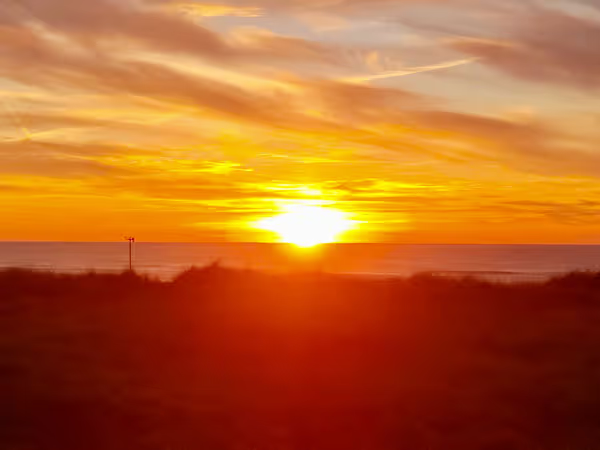
With the end of daylight savings time earlier this month, I’ve found myself paying more attention to sunsets. Initially, I thought that I’d been appreciating the pop of color at the end of the day more now, simply because it’s darker and drearier this time of the year. Plus, with fewer daylight hours, the sun now sets just as my workday ends, adding to the likelihood and satisfaction of catching a vivid sunset on my drive home. After a particularly stunning sunset the other night, though, I did a quick Google search and found out that sunsets don’t just seem prettier this time of year, they actually are.
To understand why sunsets are so stunning in the winter, we should first understand why sunlight appears to be a different color as the sun goes down, compared to when it is higher in the sky. Atmosphere scatters blue light, but allows red light to pass through. Around midday, when the sun is highest in the sky and beaming straight down, sunlight will appear bluish white. As the sun drops lower on the horizon, it has more atmosphere to cut through. Blue light is removed and sunlight appears in vivid shares of red and orange.

During winter, the angle of the earth’s rotation and sun as it sets make sunsets even more enjoyable. The earth spins closer to the sun this time of year and, “the angle the sun takes setting makes sunset colors last a bit longer,” according to Stephen Corfidi, National Oceanic and Atmospheric Administration (NOAA) meteorologist.
Winter weather also plays a part in creating stunning winter sunsets. Out here on the coast, we already enjoy clean offshore air. This means there is less pollution to dampen sunset colors than we would experience in places with more pollution and smog.
“Clean air is, in fact, the main ingredient common to brightly colored sunrises and sunsets,” said Corfidi. In the summer, humidity in the air can wash out colors and create hazy sunsets. In the winter, on the other hand, low humidity and cleaner air, especially after rain, can help create striking sunsets.
You might be wondering how Washington’s famous rain, wind, and storms affect our sunsets. Of course, a particularly stormy day might mean there won’t be a sunset to enjoy at all. Other times, the sun can break through rain clouds and sunlight will refract through large raindrops. Clouds can also help create beautiful sunsets by reflecting colorful light back to us.
Sources
Corfidi, Stephen. “The Colors of Sunset and Twilight.” NOAA/NWS Storm Prediction Center. https://www.spc.noaa.gov/publications/corfidi/sunset/. Accessed 21 November 2021.
Edwards, Anthony. “The Science of Sunsets: Why Golden Hour is Especially Vibrant in Seattle’s Spring.” The University of Washington Daily, https://www.dailyuw.com/science/ article_17e463d0-8dc4-11ea-afd7-eb8b0376fbbc.html. Accessed 21 November 2021.
Forgione, Mary. “Winter Sunsets and Sunrises Really Are More Spectacular. Here’s Why.” LA Times, https://www.latimes.com/lifestyle/story/2020-01-10/southern-california-spectacular-winter-sunsets. Accessed 21 November 2021.
Resnick, Bryan. “Why Sunsets are Better in the Winter.” Vox, https://www.vox.com/science-and-health/2019/11/22/20970563/sunset-science-explained-rayleigh-scattering. Accessed 21 November 2021.
Photo 1 by Tina James
© Holly Duffy, November 2021
Touch whale bones, examine shipwreck artifacts and connect with the coast's living history.

Support our mission, get involved in educational programs, or contribute through donations and volunteering.