Forests
All About Old Growth Forests
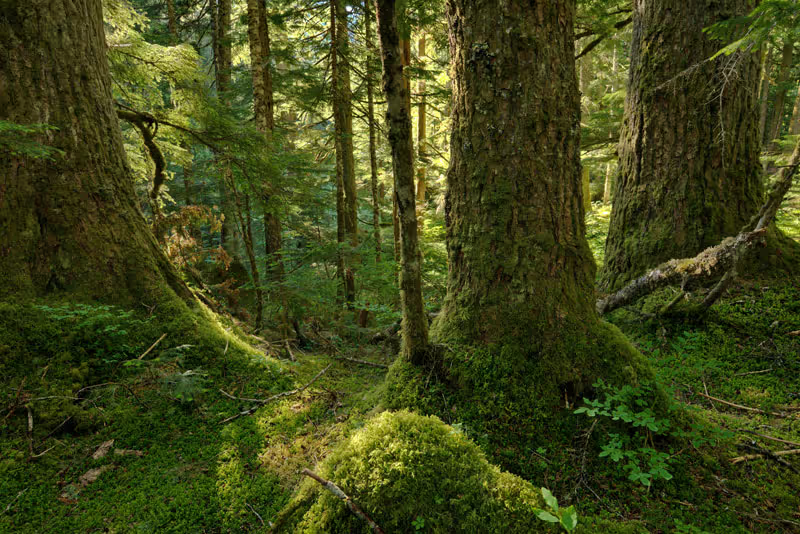
A forest is considered to be an “old growth forest” if it has “attained great age without significant disturbance and thereby exhibits unique ecological features.” However, this definition is subject to debate. In the 1970s, scientists used “old growth” to describe forests that were at least 150 years old and featured biodiversity. Today, “old growth” is often defined as forests containing large, very old trees that have been left untouched by humans. Under this definition, more of the world’s forests are considered old growth forests.
Characteristics of old growth forests
While characteristics of old growth forests will vary by location and tree species, it’s often agreed that they have more “snags” or dead trees and decomposing wood than younger forests. Left undisturbed by humans, trees in old growth forests are large and forests are dense. Forest canopies in old growth forests are also thick and layered, allowing light to peek through. Understory plants like ferns, shrubs, and moss thrive in these conditions.
Old growth forests contain ecosystems that support a range of biodiversity and provide habitats for many birds, mammals, and amphibians, including many protected species.
Old growth versus young growth
Trees in young growth forests tend to be crowded together, which allows them to absorb more carbon overall. However, as a tree ages, its carbon absorption rate accelerates, which allows old growth forests to become “some of the planet’s biggest carbon storehouses.”
Once gone, old growth forests are not easy to replace–it can take two to three human lifetimes for old growth to return. On top of that, old growth deforestation contributes to climate change. When old growth trees are cut down, they release their massive carbon storehouses into the atmosphere as CO2. This is one reason for recent efforts against deforestation.
In the 1990s, President Clinton’s Northwest Forest Plan, sought to conserve 24.5 million acres of Federal lands over 100 years. The Northwest Forest Plan included a forest management strategy to protect more than 1,000 species that were dependent on old growth forests, including the Northern Spotted Owl. Until 2020, trees over 21 inches in diameter in six national forests throughout the United States were protected. Today, environmental groups and scientists are working for better forest management in an effort to mitigate climate change, focusing on both old and young growth forests with conservation and replanting efforts.
Sources
Blanckensee, Sienna. “New Growth Forest vs Old Growth Forest,” Weather Intelligence: https://weatherintelligence.global/new-growth-forest-vs-old-growth-forest/. Accessed 4 February 2023.
McCarthy, Will. “What is an Old Growth Forest?” Yale Climate Connections: https://yaleclimateconnections.org/2019/12/what-is-an-old-growth-forest/. Accessed 4 February 2023.
Koberstein, Paul & Applegate, Jessica. “Tall and old or dense and young: Which kind of forest is better for the climate?” Mongabay: News & Inspiration from Nature’s Front Line:https://news.mongabay.com/2019/05/tall-and-old-or-dense-and-young-which-kind-of-forest-is-better-for-the-climate/. Accessed 4 February 2023.
“Old Growth Forests,” BritishColumbia.gov: https://www2.gov.bc.ca/gov/content/industry/forestry/managing-our-forest-resources/old-growth-forests/old-growth-values. Accessed 4 February 2023.
“Old Growth Forests,” Wikipedia: https://en.wikipedia.org/wiki/Old-growth_forest. Accessed 4 February 2023.
Samayoa, Monica. “Rule Protecting Northwest’s Old Growth Trees Under Government’s Ax,” Northwest Public Broadcasting: https://www.nwpb.org/2020/08/12/rule-protecting-the-northwests-old-growth-trees-is-under-the-federal-governments-ax/. Accessed 4 February 2023.
Photo by Ron Otsu on Unsplash.
© Holly Duffy, February 2023
Touch whale bones, examine shipwreck artifacts and connect with the coast's living history.

Support our mission, get involved in educational programs, or contribute through donations and volunteering.